

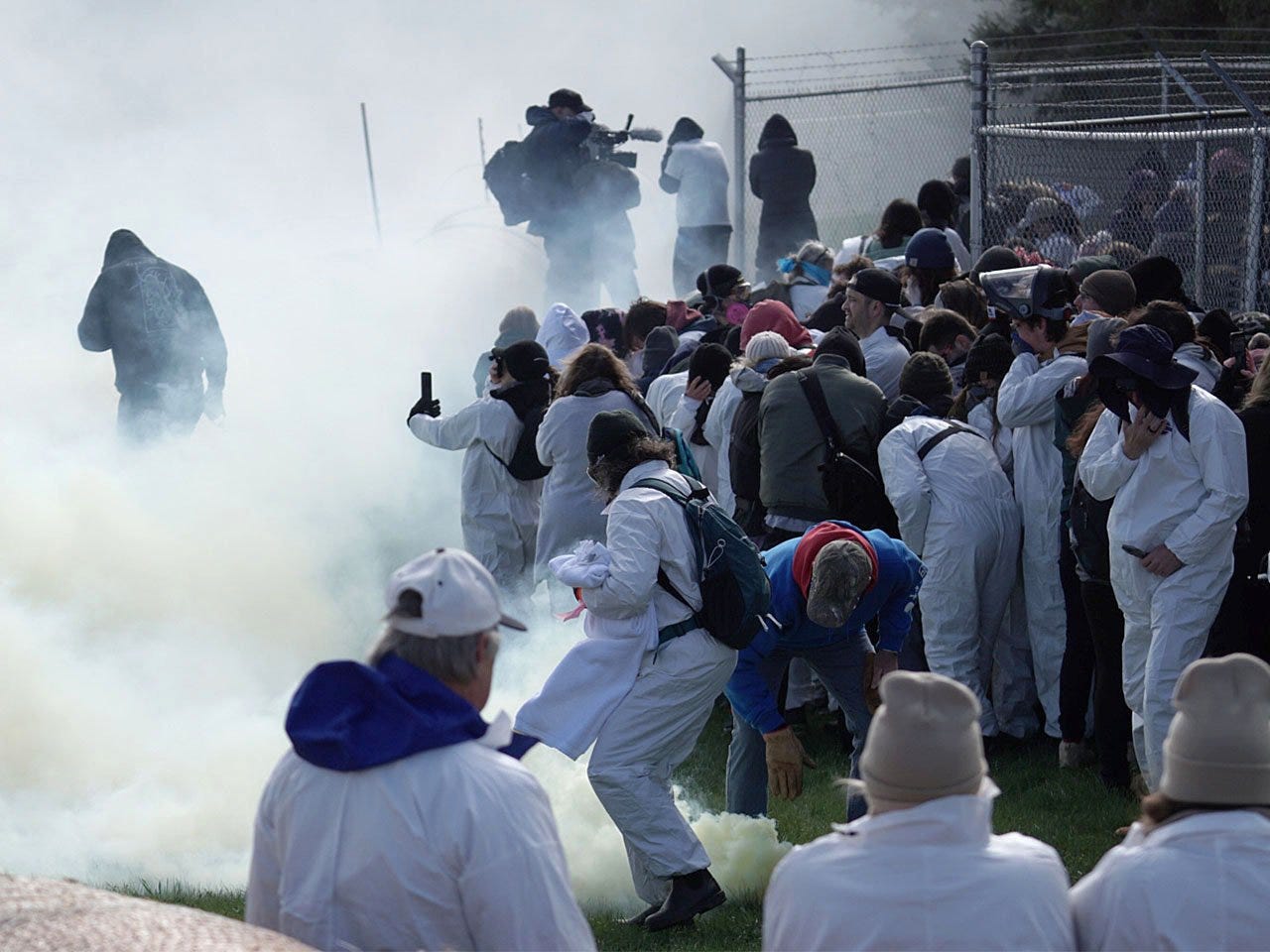
Our plan to save thousands of dogs from Ridglan Farms exploded with a can of tear gas.
On April 18, 1000+ people converged on Ridglan Farms with a seemingly simple plan. Rescue the dogs from criminal abuse using every nonviolent means possible. But the police and industry responded with brutal violence, including attacking a disabled grandmother. Few of our rescuers even got near a building. Not a single dog was freed.
What went wrong? There were at least four major factors in the plan’s failure: overconfidence, complexity, poor communication, and rigidity. But before I can unpack those failures, let me describe in more detail the actual plan.
The April 18 Plan
Our strategy was to use the “flexibility, scale, and intelligence of 1,000+ nonviolent rescuers to overcome any barriers to the mission,” i.e., to rely on teams to act independently on site and find creative means to rescue the dogs. Our plan, in short, was to have no plan—but rely on nonviolence, problem-solving, and the sheer number of the rescuers instead. The most important factors in giving our rescuers this freedom of action was to clear the site of obstacles, including both physical barriers and security or police.
We had special teams who volunteered to arrive early to clear the physical obstacles within minutes—fencing and doorways, specifically—but clearing the site of security and police would require an element of surprise. For that reason, our team leads were instructed that, while the date of the action was set for Sunday, April 19, circumstances such as weather might require a change. The final briefing could happen at any time, and at any place, and team members were asked to be prepared to adapt.
That is precisely what happened in the weeks before the action. Locals told us that the Dane County Sheriff’s office, which up to this point had been civil and respectful of our rights, was planning to shut down the entirety of Blue Mounds Road on April 19. Checkpoints would be set up at roads, and only those with an ID showing a local address would be allowed into the area. That would make a demonstration, much less a rescue, impossible.
“We have to move before they’ve set up the checkpoints,” I told our leadership team in a meeting a week prior to the action. “That probably means going on Friday, right when people arrive.”
We had envisioned this possibility from the start. I first mentioned the possibility of moving on Friday in late March. But there were two problems. The first was that moving on Friday would leave people untrained—and perhaps unprepared—for the action. While we had tried to implement online trainings in the weeks prior to the action, nothing is as good as an in-person walkthrough. And many teams would not have even met in person yet.
“We are just going to have to trust our team leads,” I said. “Because it’s a choice between doing a rescue with less training, or not doing a rescue at all.”
The second was that the weather was not cooperating. What was initially forecast as rain became thunderstorms and tornados in the days leading up to Friday, April 17.
“I don’t think we can safely rescue puppies in this weather,” one member of the leadership team shared. On Thursday night, the team was evenly split on whether we should move the next day.
“Let’s keep open the possibility of doing Friday,” I said. “But unless the weather improves, we are delaying.”
On Friday, our recon teams were telling us that no police were on site, much less setting up perimeter checkpoints. Locals told us, surprisingly, that there was not even private security visible on site. One volunteer even told us he used an infrared camera to confirm there was only one human being at Ridglan Farms. Many members of our team felt that we should move forward.
“This is our best opportunity to catch them off guard,” one told me. “They are going to be prepared over the weekend.”
But the weather was getting worse. A flash flood warning was issued in Dane County, and a local reporter told me that his station was not even allowing him to cover our briefing due to tornado risk. I called off the Friday mission. It’s too dangerous for the dogs, I thought. We would wait until Saturday morning to reassess.
The rest, of course, is history. By Saturday morning, police cruisers were present and following any cars that drove by Ridglan Farms. One pulled over at the intersection of Highway E and Blue Mounds and appeared to be preparing a checkpoint. There was even an armored personnel carrier on site. We had to move immediately if there was going to be any chance at rescuing the dogs. And even if we moved immediately, we had to adapt. As I drove towards Ridglan, I sent a message to our team leads chat.
“We have to pivot. Wait for everyone to mass up and move in one large group,” I said. We instructed breach teams to hold back and arrive at the same time as the larger mass of Red/Yellow activists.
But before I could organize anyone to make this pivot, I was arrested on a public road. Within minutes, tear gas canisters were flying through the air. The police refused to arrest or detain people — their main approach to stopping us on March 15 — and assaulted people instead, preventing anyone from getting anywhere near Ridglan Farms.
Four Major Mistakes
So what were our mistakes?
The first mistake was overconfidence. We assumed, based on the prior action, that the police would use the same tactics they used on March 15: detention and arrest. On April 18, they used brutality instead. I played an enormous personal role in this mistake, as I spoke to many people about how I doubted the likelihood of police violence.1
“This is a progressive county where the Sheriff has pronouns in his bio,” I said. “And there’s never been police violence at any open rescue in animal rights history.”
Indeed, the main threat of violence we perceived was from agent provocateurs within our own movement.
That was a mistake. And while we can’t be sure there was anything that could have been done to overcome police violence, we could have engaged in better scenario planning —consideration of different assumptions about the state of the world we were in—to reflect that possibility. When evidence started coming in that the police might shift to violence—e.g., when Sheriff Kalvin Barrett made a “crazy” video accusing us of violence in the days before the protest—we should have recognized more quickly that our assumptions about police were wrong.
The second mistake was complexity. Large and uncertain challenges require simple plans, especially when they involve large numbers of people. And our plan, beneath its surface simplicity, was far too complex. Nearly a dozen independent teams, from recon to breach, were positioned all over the facility and developing very specific and detailed operational plans. When the chaos and uncertainty inevitably took over, those plans fell apart, and some of our most trusted teams were quickly neutralized. It would have been better for us to keep plans simple—and vet them with contingencies, such as an escalation in police violence. In short, we spent too much time on details that didn’t matter (e.g., how to move a haybale) rather than the high-level simple factors that were more important to mission success (e.g., how to handle a large police presence).
We should change this. Simplicity should always be our mantra, especially when organizing at scale.
A third mistake was poor communication. While the primary reason for moving away from Friday was the weather, a secondary factor was the surprising number of people who did not get the memo that they needed to be ready for action starting on Friday at 6 pm. There is an old mantra in communications research—that you have to repeat a new idea at least 7 times before it sinks in—and we did not do this enough. Worse yet, some people got conflicting messages, partly because we didn’t establish a single source of truth until relatively late in the action. Even our Beagle-Bot—an AI chat agent trained on the documents we prepared—often got things wrong as a result.
Most importantly, we did not have great communication protocols at the action itself. Two days before the action, we did a quick walkthrough of how our Overwatch crew—the set of people responsible for providing key information—would communicate with team leads. It was clear that there were serious deficiencies. Some members of the Overwatch crew, for example, did not understand the lexicon we were using (“What’s core placement?”) or the plan (“Where do rescuers take the dogs?”). We should have focused 10x more on having robust and effective communications strategies. For all future actions, there should be a clear communications memo—setting out who is communicating with whom, and how—right at the start of our action planning.
A fourth and final mistake was rigidity. We were too focused on the primary scenario we envisioned—surprising the police, and facing mass arrest rather than violence when they arrived—and not sufficiently prepared to adapt. We were also too focused on getting maximum participation and not sufficiently willing to lose numbers even if it enhanced our ability to adapt.
Take, for example, the schedule. We started on Sunday, moved to Friday, then ended on Saturday. But we didn’t do enough operationally to ensure that those changes could operate seamlessly. We told people to come on Sunday but did not have the communications norms or culture to change this quickly. This is partly because we wanted to avoid complexity, which is also very important. But there is a way to have simple plans that are also flexible. It might have been enough to tell people, “Come on Sunday, but be prepared for any other time” more explicitly. More generally, for future actions, it may be wise for us not to spell out a single date at all.
“We don’t know exactly when the action will be,” we may have to say. “But the call to action could come at any time.”
That may limit our numbers. But if it ensures flexibility of action, it’s worth it.
What Failure Means
There are, I have no doubt, other failures in our planning. The list above is not meant to be exhaustive. But I want to end with a line from one of my most favorite talks, by entrepreneur (and some-time animal advocate) Vinod Khosla.
“Failure does not matter. Success does.”
Khosla is not trying to suggest that failure isn’t painful. Especially in a context like ours, it’s heartbreaking and demoralizing and even traumatic. Dogs are currently trapped at Ridglan Farms, awaiting torture or death, because we failed.
What Khosla means is that failure is inevitable when trying to solve hard problems—finding a cure for cancer, ending wars, or creating social change. The key is to not let the fear of failure take you off the path of success. Many people, perhaps most people, give up on hard problems when they experience failure. It’s too painful. But that is the only way to guarantee that failure is permanent. In contrast, if we remain willing to fail—and learn from the process—failure doesn’t matter. To the contrary, it’s an essential step on the path to success.
Today, we are engaging in a debrief of our entire rescue community for that purpose. There are so many perspectives and ideas and solutions from this community that I am optimistic that we will learn from the failure of April 18 and continue on the path to success.
Indeed, that is already happening. The unprecedented attention from the action—4x as much search traffic as the March 15 rescue, according to Google Trends—is pushing our culture and institutions in a positive direction. For example, after the April 18 action:
Rep. Mark Pocan (the district’s own congressman) publicly called for the Ridglan dogs to be released and shelter networks to begin preparation.
The leading Democratic gubernatorial candidate publicly demanded a “real transition plan” for the Ridglan dogs
Two Dane County Supervisors, including Rick Rose, condemned police conduct and called for investigation.
We did not save the dogs, but we are in a stronger position than we’ve ever been to get them out. (Yesterday, I whipped up a quick memo with three approaches to seizing this current moment.)
But to find those paths, we must confront our failures directly. Overconfidence, complexity, poor communication, and rigidity were the failures of our leadership team that I saw. What failures did you see, and how do you think we can use our failures to get us back on the path to success?
I feel great guilt over this and apologize to everyone who was harmed as a result.
I joined Substack and The Simple Heart for one reason. You are inspiring. The world would be a much better place with more people like you and the volunteer rescuers in it. I feel proud of everyone who tried and want to say thank you.
Whether 165 or 1,000 attempted rescuers...it was one hell of a good and righteous effort!
Further in my opinion this will greatly raise political opinion as regards the inherent misery being inflicted on farmed animals across our country!
Please keep up the outstanding leading edge campaign!