

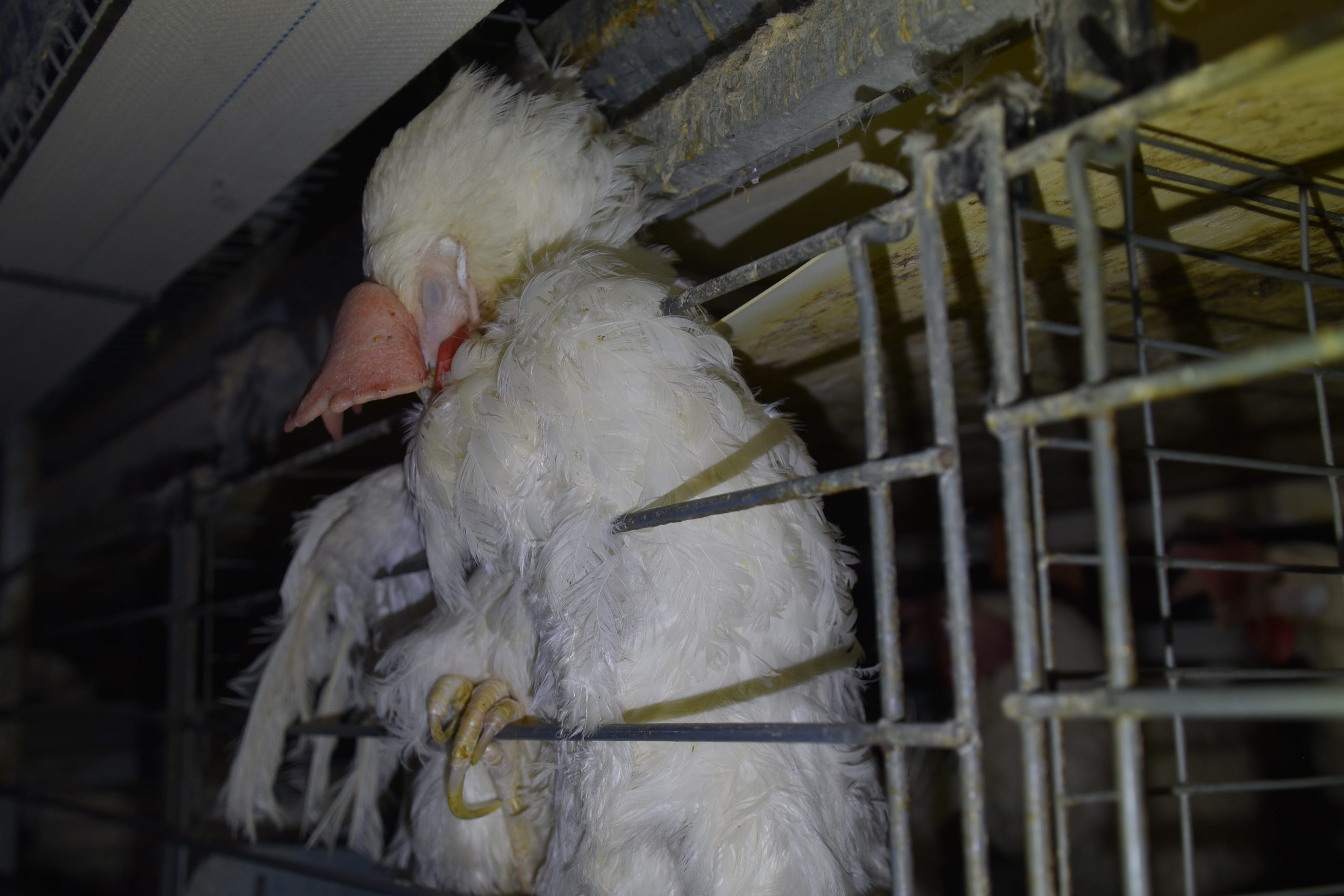
In 2016, I walked into one of the most celebrated egg farms in California, Sunrise Farms, and saw something that I could hardly believe. The company was illegally confining thousands of animals in so-called “battery cages” – wire enclosures, about the size of a filing cabinet, where a dozen or more animals would live their entire lives.
This was a clear violation of one of the most famous animal welfare laws in the nation, then referred to as Proposition 2. But when we reported this abuse to the authorities, they did not rush to investigate animal cruelty. Instead, they charged and imprisoned me. FOOTNOTE (Don’t fret for me. My conviction was an important experience and is setting us up for a potentially-groundbreaking legal precedent.)
The government’s refusal to investigate the abuse at Sunrise Farms was not unusual. The animal rights organization Animal Equality found that only 1 in 300 cruelty complaints in the UK leads to prosecution. The Animal Welfare Institute obtained government records showing that only 12 out of 44 state farm animal protection laws show evidence of any enforcement at all. (Ironically, California’s battery cage ban was counted as a success because of a single instance of enforcement.). For many decades, the United States Department of Agriculture’s own inspector general has described penalties faced by animal abusers as “basically meaningless.”
Why does the government consistently refuse to act to stop animal abuse? I’ve worked on a number of important counter-examples, including our recent successful effort to shut down Ridglan Farms. And what I’ve learned is that most people don’t have the right answer to the question of why the government refuses to act. Let’s dispose of 3 bad theories first, before we get to 3 good ones.
Bad Theory 1: Better arguments. Most people think that offering the right argument can change government officials. Sadly, there is little evidence this is the case. Indeed, one recent study showed that compelling evidence had the opposite effect: merely entrenching a politician’s existing views. This has been my experience. In the Sunrise case, government officials simply ignored their own eyes and pretended the company was not using battery cages to house its hens.
Bad Theory 2: More public support. Theoretically, in a democracy, government officials should be responsive to public opinion. But this is very rarely the case. One prominent study found that “the preferences of the average American appear to have only a minuscule, near-zero, statistically non-significant impact upon public policy.” (While there has been pushback on this finding, even the critics only believe that public opinion sometimes matters.) The battery cage ban in California was the most popular ballot initiative in state history at the time it was passed, with 8.2 million (63%) voting in support; that didn’t help us get any enforcement.
Bad Theory 3: Money. This last theory is the closest we’ve gotten to the truth. The job of an elected official is effectively fundraising, and there is evidence that money can buy access to government officials. Surprisingly, however, there is little evidence that this money actually gets results. One study took 98 randomly-selected legislative issues in Washington and “found virtually no impact of money on outcomes.” Once again, the Sunrise case was instructive. There was actually significantly more money spent on the pro animal side, than the anti-animal side: $13 million for, and less than $0.5 million against. That hasn’t helped us in getting the law enforced.
So what, then, are the good theories?
Good Theory 1: Regulatory inertia. Change is hard. For this reason, there is a well-documented bias towards the status quo. This is particularly true in institutional contexts, where creating change is akin to turning the Titanic. But inertia can be solved by shifting the incentives so that the government is compelled to act. Make it more painful for bureaucrats to ignore the issue, then to act. When prosecutors ignored us in the Ridglan case, we created so much pain for them that doing something for the dogs – anything – became the safer.
Good Theory 2: Regulatory capture. Even when a government agency is prepared to engage in some form of enforcement, however, there is an even bigger problem: the agencies are captured by animal abusers. The USDA, which often calls the industry its “partner,” is perhaps the best example. But capture can be solved by finding turncoats within the system. Even a few key figures – a judge, an expert, or a whistle blower – can quickly destabilize a system that has been captured by special interests. When the industry tried to capture the system in the Ridglan case, we found turncoats – Judge Rhonda Lanford, whistleblowers from the company – who destabilized efforts to control the legal and political response to our accusations against the company.
Good Theory 3: Inattention. While public support, alone, does almost nothing to inspire action, support + attention can work miracles. For example, at Ridglan Farms, even the company’s owners admitted for decades that its work was deeply unpopular. It was not until the firestorm caused by the company’s attempts to prosecute me that the abuse of dogs at the facility got the attention – from the media, the public, and eventually government officials – that it deserved.
Now we’ve won and tens of thousands of dogs will be spared from a lifetime of torment. But that just leads us to the next challenge: can we use this same model to push the government to take on the entire industry next?
Wasn't Plea Deal Priya supposed to be a powerful warrior for animals? Isn't she walking dogs and cleansing chakras now? 🤔
You are arguing for nicer ways to abuse animals. Grow up.