

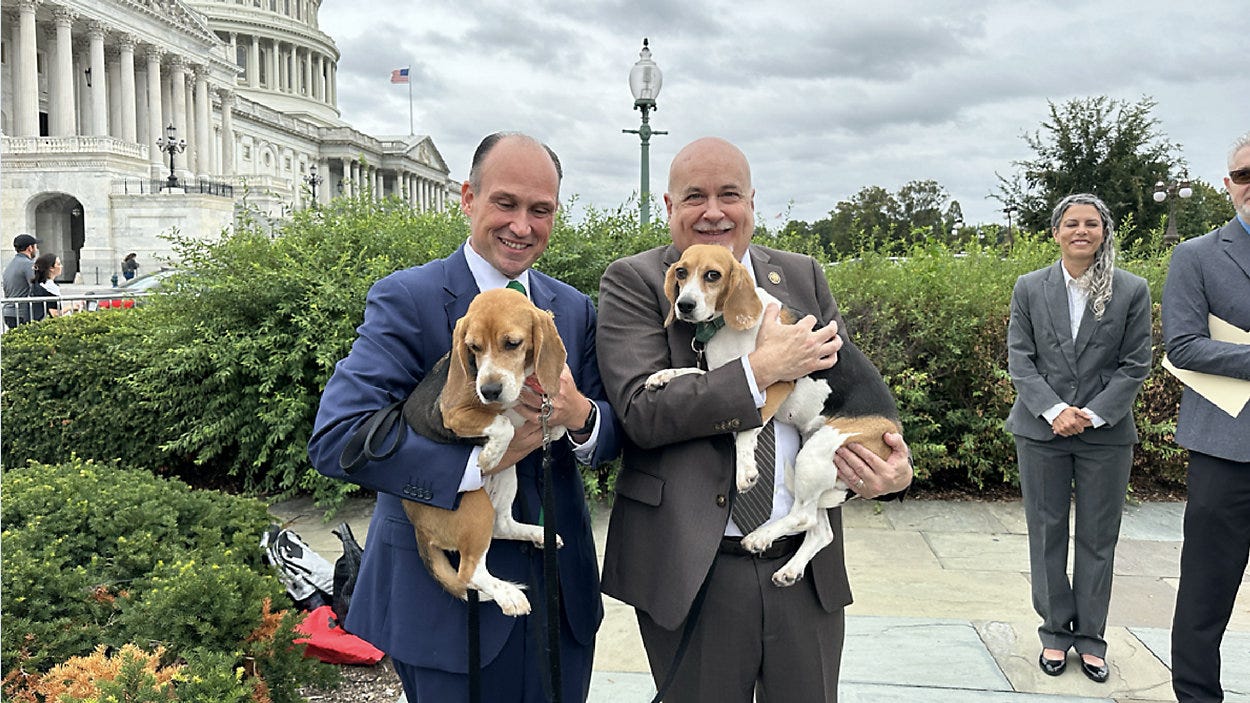
On Wednesday, September 23, Rep. Mark Pocan and Rep. Nick Langworthy proposed legislation that could save tens of thousands of dogs from cruel experiments, the COMPACT Act. The legislation, which would end all NIH funding of experiments on cats and dogs, will kick off what will likely be the most important political fight in the history of animal experimentation. Billions of dollars are used by the federal government on unethical experiments. That entire ecosystem of lobbyists, contract researchers, and other beneficiaries of taxpayer handouts will fight tooth and nail to keep the money in place.
It’s crucial we prepare for that fight. Today, the Save the Dogs coalition will have our first call to do just that—and Rep. Pocan will be joining us.
Join our first call in the fight to pass the COMPACT Act tonight (September 27) at 8 pm ET / 5 pm PT —and learn from Rep. Pocan himself about what each of us can do to save the dogs trapped in labs. RSVP here and join at savethedogs.io/zoom.
How do we ensure our campaign has maximum impact? Here are a few key lessons from the research.
Authentic contact from constituents still makes a difference. A 2015 study shows that legislators who were randomly assigned to receive constituent calls on a policy issue were 12% more likely to support the policy. Legislators correctly assume that every person motivated enough to call probably represents 10x as many who support the policy. You can help us pass the COMPACT Act by making a call today.
Consider making a small donation—then asking for a meeting with the senior legislative staff. David Broockman and Josh Kalla, two leading scholars who have been supportive of our work, found that senior legislative officials were 3-4 times as likely to meet with constituents who identified themselves as donors to local races. Give a small amount, even $10, and then tell the staffers you are a donor who would like to meet with the legislator (or their senior staff) about the bill.
Have dinner with legislative staff rather than formal lobbying. Traditional forms of lobbying are rapidly diminishing in impact, as the sheer volume of lobbyists and issues has increased so rapidly. Meeting legislative staff for a meal—so-called “social lobbying,” which focuses on building a social tie rather than just a transactional political relationship—can lead to better results. Ask the staff of your House and Senate members if they can meet you for dinner.
Empower the legislative staff to make the case for us. When outside groups made presentations to legislators, it had virtually no impact in one experiment. In contrast, when the same presentation was given by a legislator’s own staff, it increased the odds that the legislator would take the recommended position by 17%. When you meet with legislative staff over a meal, spend a lot of time listening—and empowering them to make the case with their boss.
Join a protest—and build a movement. The most powerful political movements are fueled by direct action. Evidence shows that protests, at least if they reach a certain scale and salience, can shift legislators dramatically in the direction of the protest. But, interestingly, the mechanism may not be direct. Protests’ primary effect is to inspire a larger base of support for a movement, which in turn will contact legislators authentically and fuel a cycle of political change. Join an upcoming protest against Marshall BioResources or one of its buyers.
These are just some of the tips we’ll be sharing with you on calls like the one being held today. But by far the most important factor in a campaign’s success is the number of people acting to support it. Every person counts, no matter how seemingly small the contribution. Don’t let perfection be the enemy of the good. Join the call today at 8 pm ET / 5 pm PT. And let’s find some way, no matter how seemingly small, to plug you in. Then let’s go save some dogs.
Experimenting on dogs is unnecessary and cruel and should never have been allowed.
You mentioned making calls to legislators. I have sent at least 6 emails to my congressman and senators since the compact act was announced. Are you saying that the phone calls are more effective? I know they're already sick of hearing from me. But I'll switch to calling if that does more good. ;-)
Thank you for all you're doing to free the beagles!