

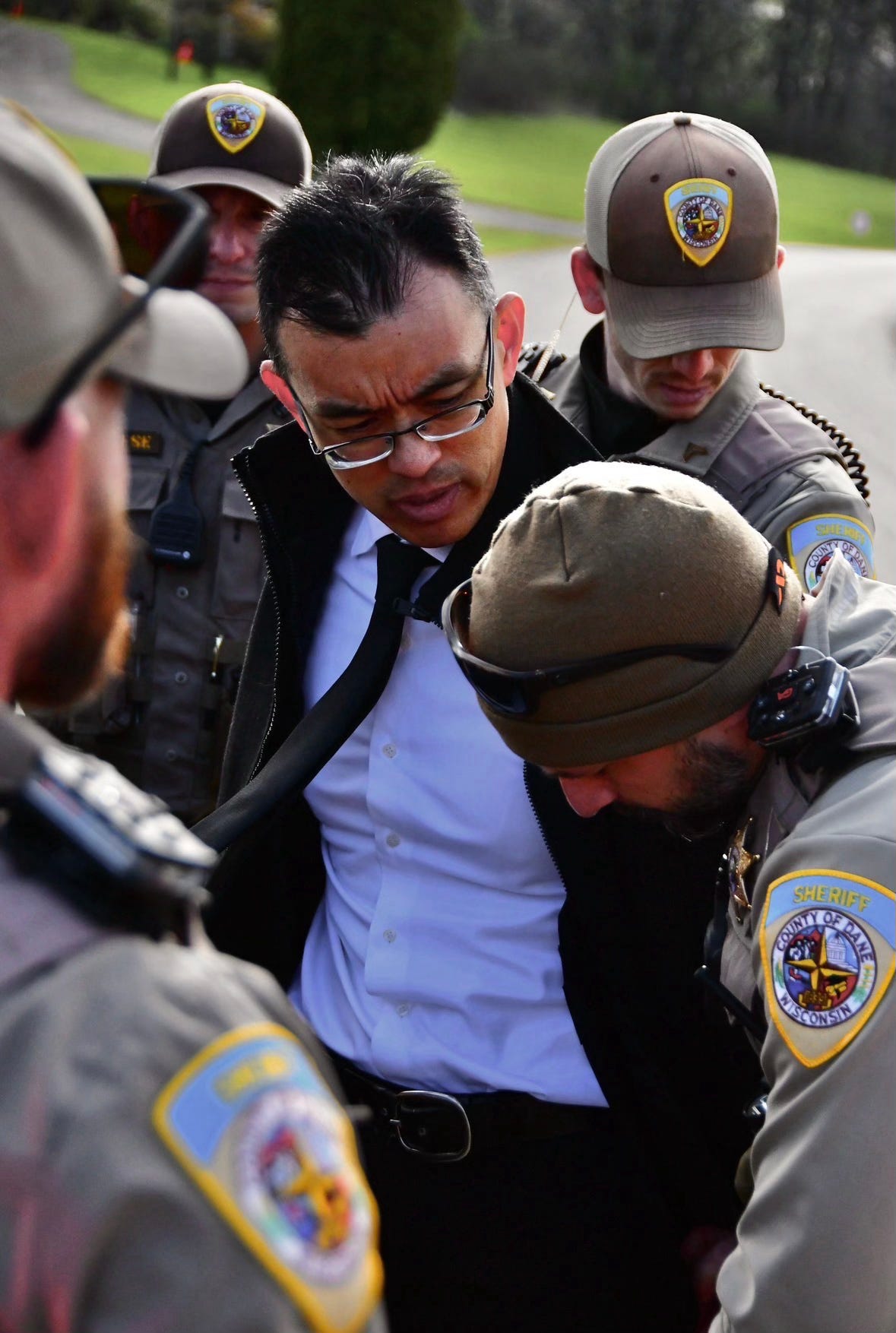
“Would you save a grub?”
It was not a question I expected from a special agent in a joint terrorism task force. Yet here I was being interviewed in a Dane County jail about insect rights.
It was just the first in a series of questions I was asked by two special agents with the FBI and state department of justice on Saturday. I answered their questions — against the usual legal advice — because I wanted to learn more about their “terrorism” investigation. And what I learned sheds light on, not just the government’s approach to the Ridglan case, but its approach to all “animal cases.”
The conflation of protest and violence. Jim, one of the agents, started the conversation by comparing our action to those of Luigi Mangione, who allegedly assassinated a healthcare CEO because of complaints about premiums.
You see a company causing harm, he explained. But it’s not okay to use violence.
“You are right. Violence is wrong,” I replied. “But grandmas rescuing dogs is not violence.”
Criminal damage and terrorism. But, Jim insisted, that’s not all you did. There were tools — wire cutters, ladders, and even power saws.
“Damaging property is not always wrong or illegal,” I responded. I asked Jim and So, the other agent, about the dog in a hot car scenario. Would they break the window? Both quickly said yes. So, then, what is different about a dog being mutilated in a vivisector’s cage?
Liberty for me…but not for thee. Jim then told me he was a hunter who killed deer to feed his family. Activists would disrupt his hunts with bells and other devices.
You can have an opinion on hunting, he said, but you can’t stop me from living my life and feeding my family.
But if we care about liberty, I asked, shouldn’t we care about liberty for all beings, including a dog trapped for years in a 2-foot-by-4-foot cage?
The right way to make change. Even if I were right morally, however, So insisted there is a right way to do things: within the law.
I agree — and the law expressly allows some rules to be broken when a life is at stake. Indeed, officers and firefighters break “rules” all the time. No firefighter is liable for breaking down a door to save a puppy from a burning building.
The line on “who matters.” We ended by coming back to their initial question on whether I’d act to save a bug.
“I read that lobsters feel pain,” So said. “Does that give you the right to break into Red Lobster?”
The two agents thought they had me. Who could possibly defend rescuing invertebrates and bugs? But they were surprised by my answer.
“We should have compassion for all animals,” I said. “And yes that includes bugs.” I refuse to kill mosquitoes who are biting me for exactly this reason.
“You want to treat dogs the way you think I treat bugs. But we don’t have to draw lines. We can simply have compassion for them all.”
The agents were stupefied. They requested, and I agreed to, an end to the interview.
My children feel that all life is equal to human life. They protect insects, invertebrates and arachnids at all costs and become furious with those who do not. It's a difficult issue, in the society we live in.... My kids are frequently upset. We are following your mission from Australia. Keep going Wayne, you're our hero!!
Well done! It sounds like you gained the upper hand. It's hard to come up with a counter point to having compassion for all.