

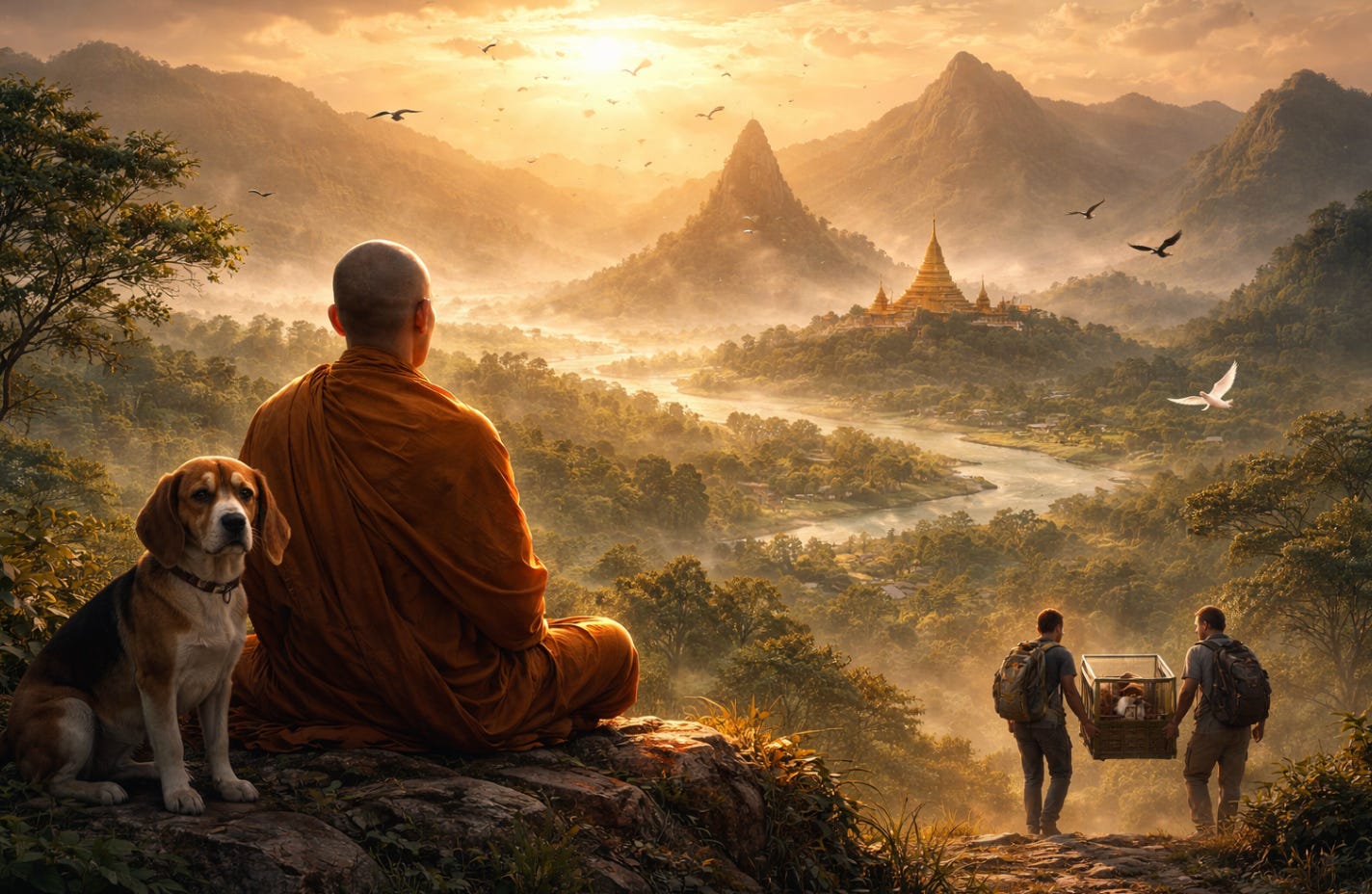
In what is arguably the most famous story from Buddhist thought, Prince Siddhartha leaves his opulent palace to see the world for what it truly is. And what he observes is utterly shocking.
An old man, in a world that felt youthful and vibrant
A sick man, in a world that he thought was filled with health
A corpse, in a world where death was almost always forgotten
An ascetic, who had given up all worldly pleasures in order to devote his life to ending suffering for all beings
His observations led him to develop what is among the most important prayers in Buddhist history.
I am of the nature to grow old. I am of the nature to grow sick. I am of the nature to lose everyone I love. I am of the nature to die. How, then, shall I live?
Siddhartha’s choiec to follow the life of the ascetic did not just change him. By becoming the Buddha, Siddhartha created one of the most important moral paradigms in the history of Earth.
But it’s so important to remember the humble beginnings of this moral revolution. Though Siddhartha was a Prince, it was not his royal status that gave him power. Though Siddhartha was filled with compassion, it was not compassion alone that changed the world. Rather, what triggered the revolution was faith: an unrelenting belief that the world’s purpose was to liberate sentient beings from suffering. He was not just one good man. He was an avatar for what we could all become—what our entire universe was meant to be.
I thought of this story today as I observed the Unitarian service at the Newington Green Meeting House in Hackney, London. It is a historic space. Mary Wollstonecraft, the pioneering feminist, was a member of this congregation. Richard Price, the renowned mathematician who gave us Bayes’ Theorem—and therefore built modern probability theory—was one of the space’s long-term pastors. The people there, 200 years after Wollstonecraft and Price, still want to do things with purpose, with goodness. They want to answer the question: How shall I live?
Yet there are so few answers being provided, whether by the Unitarian faith or anyone else, particularly for those on the secular left.
One of the under-appreciated aspects of direct action is that it provides an answer to this age-old question. How shall we live? We shall live by being the change we seek in the world. It is a formula as simple as it is challenging. But I believe, if we set the formula out, and give people a path to following it, they will choose how to live, brilliantly and bravely.
They will rescue.
It bears repeating "live by being the change we seek in the world."
I hope people here are following the Walk for Peace. It is very powerful. Their light shines bright in these dark times.
" I believe, if we set the formula out, and give people a path to following it, they will choose how to live, brilliantly and bravely."
Who is we?
What is the formula?
What gives this illusive 'we' the right to dictate anyone's path?
Where is bravery and brilliance in blind idolatry,?
Stick to animal liberation.