

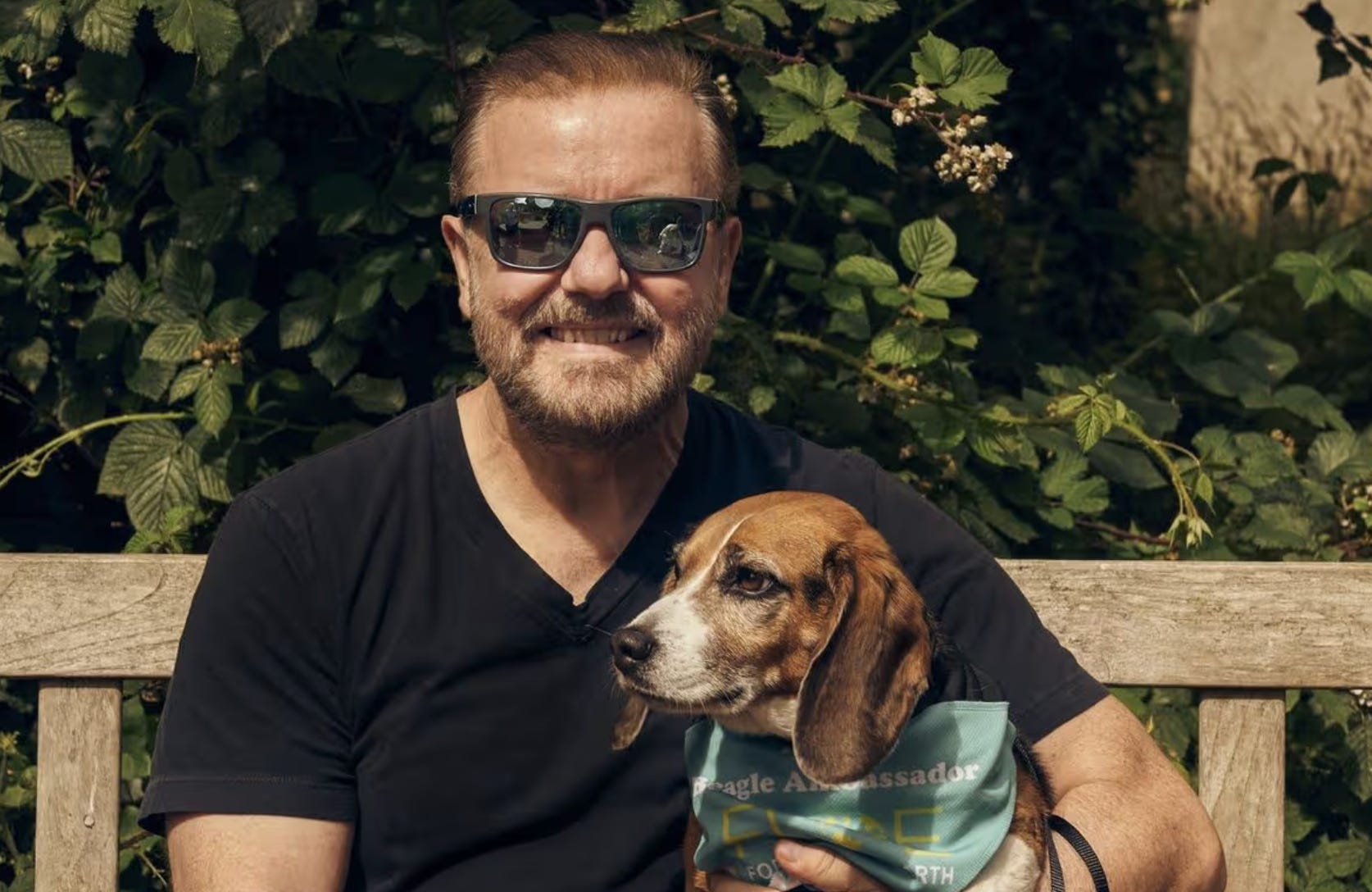
I just got word from comedian Ricky Gervais’s representatives that he is offering his full-throated endorsement of the Ridglan rescue effort. The Daily Mirror published his statement. “It’s time to release the dogs at Ridglan Farms, so they can live out their days surrounded by the love and freedom they so desperately need and deserve.”
Ricky is merely the latest influential figure to support the effort. Dr. Jane Goodall condemned Ridglan’s “atrocious animal welfare record” and wrote an op-ed to support us in the Washington Post. Musicians (Moby) and podcasters (Jen Welch) have been joining our Zoom calls for rescuers. (The legendary environmental activist and lawyer Steven Donziger is joining our next one—Sunday at 1 pm ET.) And, just a few days ago, Ridglan’s own member of Congress, Mark Pocan, condemned the company’s “alarming” mistreatment of dogs and told them to “rehom[e] every beagle.”
Yet the Dane County authorities continue to protect Ridglan and target their rescuers. Just a few days ago, a former Ms. Teen Wisconsin, Melany, went to Ridglan to pray for the dogs outside of the facility, as she has the First Amendment right to do. Ridglan cars swarmed her, boxing her in. That is a crime. You cannot falsely imprison someone on a public road. But when she called 911, the police harassed Melany—asking “Why are you wearing a dress?”—and refused to help. Indeed, they showed up at her door the next day to tell her she would face law enforcement consequences if she visited again.
What is going on?
The answer is partly Ridglan’s deep connections to the government. Ridglan’s head vet Rick VanDomelen is the chair of the Town of Blue Mounds Board. The owner’s son-in-law, Jerry Blizzard, is the town’s Constable. Ridglan, in short, is embedded in law enforcement. And while it is a crime to use public resources for private benefit in Wisconsin, that is a law that is rarely enforced.
The answer is also partly that police, even in progressive counties, are reflexively anti-protester. The police are part of the established order. They are taught from Day 1 to dislike those who seek change. The result is that even peaceful, lawful protesters are often treated like criminals by improperly-trained police.
But I think the best explanation is one that goes beyond law enforcement; it’s a culture that sees animal abuse as “not serious.” Most people care for animals. Most people hate to see them suffer. But animals are not CEOs of corporations or generals of wars. They don’t teach at prestigious universities or lead white-ribbon panels. They don’t organize galas or donate to campaigns.
And that has led their complaints to be ignored. Animal issues are seen as something that sentimental children or soccer moms care about—but not the “important” people in places like Dane County. This is a cultural pathology. Everyone, individually, cares about animals, but because it’s not “prestigious” to defend them, the system ignores their concerns. The result of this cultural pathology is that even the most brutal abuse of animals is ignored—especially when it’s undertaken by a powerful person or industry.
But this cultural pathology is now remedying.
A half century ago, when Ridglan was founded, and the US was in the middle of a Cold War, no one bothered to look twice at the fact that dogs were being radiated and poisoned en masse.
But now everyone is looking. Not just Ricky Gervais and Jane Goodall and Mark Pocan, but millions of people across the nation and world. The Milwaukee Journal-Sentinel, which has barely any following on social media, has had tens of millions of viewers flocking to its platform to follow the story.
What does this mean for the authorities?
It’s an opportunity for them to change. My friend and fellow organizer Almira Tanner set out this week why this moment is so important. It is a so-called “dilemma action,” where the authorities will be forced to choose between hard options. Comply with the power structure, or join the people in fighting it.
I can understand why the authorities have looked the other way. The system wasn’t built—politically, legally, culturally—to address the abuse of dogs. But I can’t understand why they would continue to look the other way now that we’ve reached a dilemma moment.
The nation wants these dogs protected. Challenging a powerful industry with deep ties to government isn’t easy. But the other choice—supporting the criminal abuse of dogs and targeting their rescuers—is even worse.
Over the long term, even the authorities will make the right choice.
Other stuff
With Ricky’s endorsement, the wave for the April 19 rescue is growing—and this weekend is the last time to join it. As I hit send on this newsletter, we have nearly 1,774 people signed up. To get to 2000, the exact number of beagles at Ridglan Farms, we need you to sign up—and share the sign up website with everyone you know.
My friend Lincoln Quirk, who I mentioned in my newsletter yesterday, wrote a short blog about why he was willing to go to jail to defend the Ridglan pups. The entire piece is worth reading, but the last part is particularly important. If we want change, we have to “to challenge ourselves to do more and more courageous things.”
Remember to steal all my content for this last push! We are hoping to get this thermometer past 2000 by the end of Sunday. We don’t have a big marketing budget, so we depend on people like you. For that purpose, feel free to post or share any of the content in this folder, including videos I’ve posted to my own social media! Every person you inspire to join us could be the difference between life and death for a dog.
Finally, don’t forget our last Zoom briefing is tomorrow at 1 pm ET. New recruits for the rescue are especially encouraged to join. But given that we have another special guest, Steven Donziger, it’ll probably be worth it for all of you. Join the WhatsApp community to get the Zoom link.
Excellent!!!! So good to hear! He has a big heart and people listen to him…
Thank you for not giving up, love you all that are physically participating.