

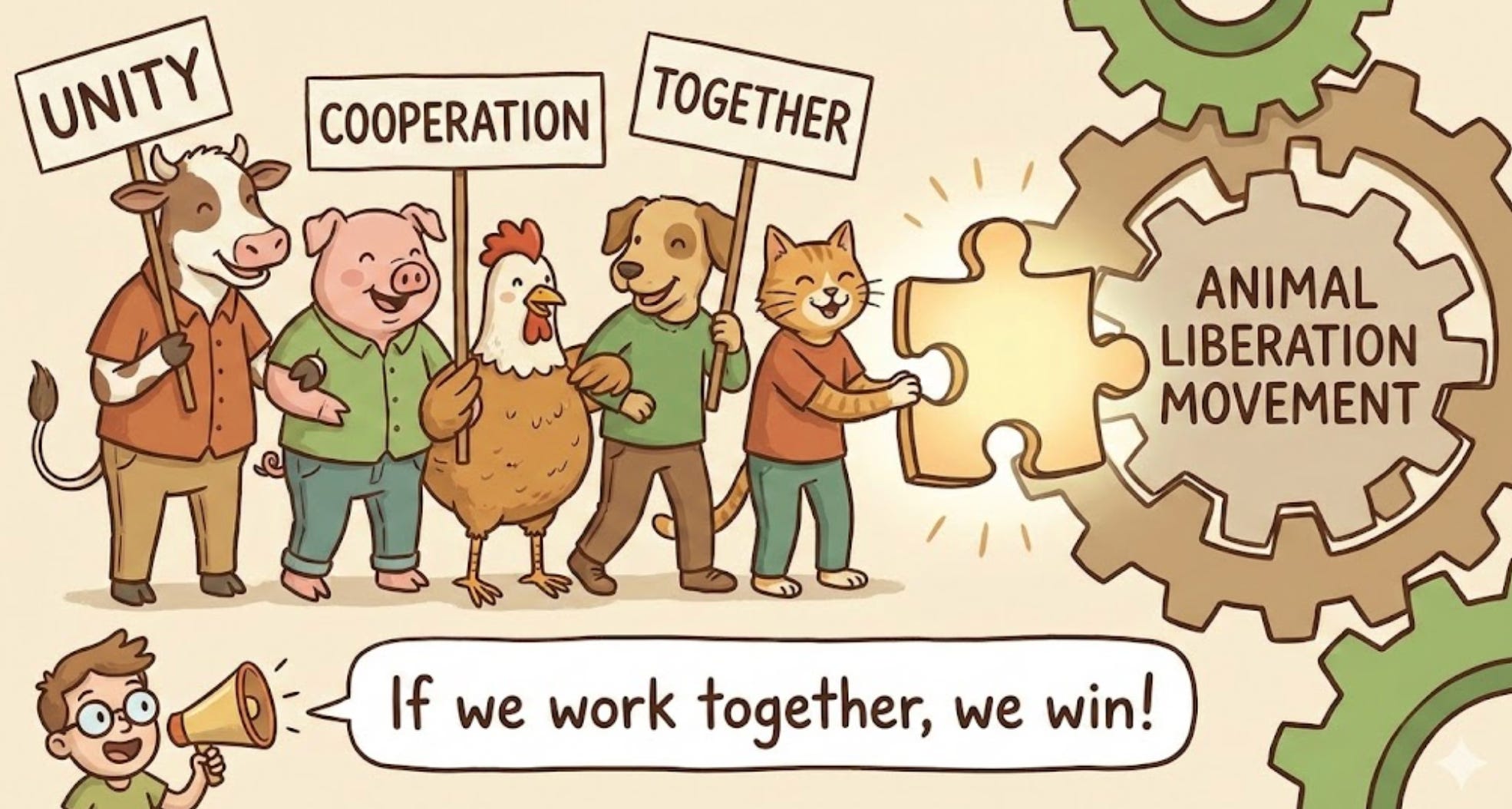
If all the vegans worked together effectively, we would win animal liberation overnight.
This is among my most controversial views. But it is also one that I hold very confidently. This is not just because of catchy sayings, like Margaret Mead’s. “Never doubt that a small group of thoughtful, committed, citizens can change the world. Indeed, it is the only thing that ever has.” It’s because, over the last half century, an increasing body of research shows that effective cooperation is the secret to humanity’s success.
The first reason is that cooperation improves our collective intelligence. Any one person can generally learn only a few difficult skills in life. Managing a garden. Picking up a few new languages. Or becoming an innovative scientist. But each of these bodies of knowledge does very little on its own. A scientist who can’t negotiate with neighboring tribes, due to his lack of language skills, may be killed off before he can make any breakthroughs. A linguist who cannot garden may starve if she cannot grow crops. And the gardener who grows food won’t be able to find a cure when his crops start to die because of a new biological pestilence. It is not just that each piece of knowledge grows the total base of knowledge. It’s that each piece cannot live without the other.
The same is true of social movements. The lawyers. The photographers. The fundraisers. And the outreach specialists. All can play a role, individually, but their work only realizes its full potential—indeed, arguably, any potential at all—when each piece is working in coordination with all the rest.
The second reason cooperation is important is that it solves the problem of infighting, which is otherwise an inevitable product of success. As movements grow, they gain more resources, attention, and prestige. The result is that stakeholders, both new and old, begin to compete with one another, rather than to achieve the movement’s intended goal. Indeed, as movements grow, many new stakeholders will join precisely because they are hoping to leech from the movement’s newfound success. This energy is toxic, and can quickly drain a powerful movement down to near death.
But cooperative norms can turn these leechers into useful movement assets. The key is to reward pro-social behavior, rather than anti-social infighting. Take, for example, a narcissist who inserts themselves into a movement to claim victories for themselves. If a movement awards the most status to those who claim credit, then this can quickly draw in and amplify the worst actors. But if a movement has different norms—awarding status to those who share credit, rather than hoard it—then even narcissists will begin to act in ways that reduce rather than worsen infighting. This is the beauty of cooperation: it can take your liabilities and turn them into assets.
I think the most important aspect of cooperation, however, is that it’s vital to create functioning feedback loops. I’ve written previously about this concept. Like a microphone that feeds into a speaker, a feedback loop can take a small initial effort and turn it into something extraordinary. But in a complex world, the only way to generally achieve such feedback loops is for many people to tightly coordinate their efforts with one another. The welfarists will pass higher standards for animal care. Then the abolitionists will point out the standards’ limitations, allowing the welfarists to pass even better ones. Feedback loops of this sort are crucial to movements for change, but they can only be maintained with cooperation.
The moral of the story? The most important thing any of us can do to help the world become a better place is to get active. But a close second to that lesson is to get cooperative. If you’re not working with others, you’re not really working at all.
I am always heartened when I connect with other animal defenders and vegans, I've never come across anything but kindness. But those defending the status quo are downright vicious. I guess that means they're feeling very threatened. I do believe we are strong together and it's gaining momentum. There will be a world change in how we view and understand the other non-human beings we are on this spaceship together with, and massive changes will follow. For the Animals