

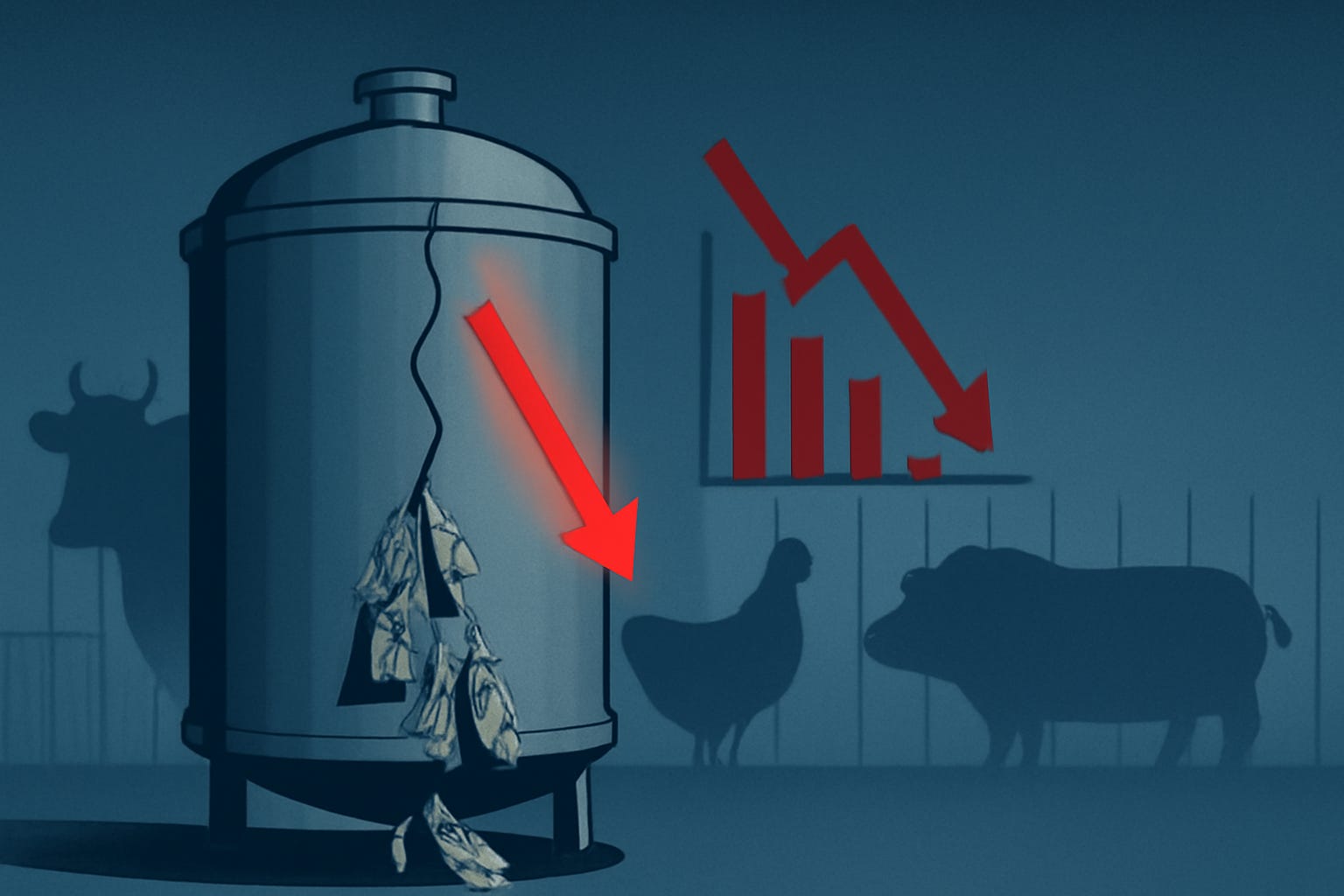
I’m not usually surprised by things in the animal rights space. But I ran across data yesterday that was shocking: in the last quarter, there was apparently $0 in recorded investment for cultivated meat. Over the last few years, an enormous amount has been written on the potential of this technology. Literally billions of dollars have been spent to develop ways to take the animals out of meat. Yet, to date, there is no product on the market — and it does not appear a product is on the way to success.
There are a number of explanations for this, all of which have some merit.
The first is that the technology has not arrived. Open Philanthropy, among other organizations, has noted that there are significant scientific problems that have yet to be overcome, including how to protect cultivated meat from one of the great plagues of life on this earth: infection by micro-organisms. While living organisms have immune systems, clean meat vats do not. That makes biosecurity a nearly-insurmountable problem, at least on a cost effective basis.
Another explanation is political economy. Cultivated meat bans have passed across the country, but those are not even the main political obstacle for the industry. Rather, the enormous political apparatus in support of animal agriculture, including tens of billions of dollars in subsidies every year, create a bulwark around the incumbent industry of animal-based meat. If even 10% of the subsidies from animal-based ag were shifted towards cultivated meat, perhaps the new technology could compete.
A third explanation is consumer preferences. The Make America Healthy Again movement, led by RFK, Jr, is the latest incarnation of a powerful movement towards natural and unprocessed foods over the last decade. There is merit to these arguments — processed foods have been a calamity for human health — but they are misdirected against products like clean meat, which unlike processed meats do not cause cancer or heart disease. That may provide little solace for cultivated meat companies, however, as consumer preferences are highly resistant to fact-based persuasion.
I think a fourth explanation, however, is the most important. The technology was pushed forward before there was a theory of alignment. Alignment is a concept that originated from economics but that has now been brought up most often in the context of the development of artificial intelligence. And the question of alignment is this: how do we ensure that a system, organization, or technology is aligned towards the values we originally create for it? Our food system is already profoundly misaligned from the values that matter to us. It poisons our air and water. It sickens our families. And it brutally tortures sentient beings on a scale never before seen in history. In a misaligned system why should we expect any solution to work? It’s like trying to deliver a cancer drug in a warzone.
Alt meats are indeed an important part of the solution to the atrocities we commit against sentient beings. But the first step must be to create the incentives for alt meat to actually thrive — not just economically, but politically and culturally. For that to happen, what is needed is a movement.
Soy is one of the few mass produced vegan foods that contains most or all of the proteins humans need. So, tofu is hunger-satisfying, this probably accounts for a lot of its staying and gaining power. Soy also promotes estrogen, I've heard, so keeps the peace a little better maybe? Oats are soothing to the nerves, accounting some for the appeal of oatmeal breakfasts. What if micro-regions like Maine's "midcoast" were to develop cooperative mass production of soybeans and oats and a few other rock-solid nutritional items? That could provide local livelihoods, engage people in their own food production, & might reduce shipping & packaging costs somewhat. A little research could figure out "horticultural guilds" around soy and other plants, like the famous "squash-beans-corn" configuration that Southwest Ancient Americans follow(ed). Another thing that plays in is feeling a strong local or regional culinary identity which lab meats definitely miss. Not sure what that would be in Maine, however . . .
So all I have is vibes and hunches, not actual knowledge — but with that caveat, I'm not surprised by this trend, nor by the general decline in plant-based animal product sales of which it's a part. I don't think the news is as bad as it looks, though.
Most of the new products I've encountered the past few years seem to have emerged from a Silicon Valley / big capital mindset that (surprise) completely misread people's appetites, both literally and culturally. They follow the Beyond / Impossible model: ultraprocessed, high-fat products that are too expensive for most people and feel like embodiments of factory farming and the Big Ag system that people dislike even as they rely on it.
Of course something similar can be said about commercial animal products—but meat doesn't *feel* like that to the average consumer. At a visceral level it's an authentic, natural product rather than something that was extruded on an assembly line.
Even as those products fizzle, though, other plant-based proteins are flourishing. Some are traditional types of food: tofu sales keep going up, as do soybeans. Others are established brands: Field Roast, Upton's, Morningstar. I suspect they've thrived through a combination of taste and presentation (and in Morningstar's case, reasonably accessible pricing). And then there are small, innovation-forward companies like MyBacon (or, here in Maine, Midcoast Vegan) who are doing incredible things with minimally processed ingredients, and selling like gangbusters.
They feel—the products themselves, and also the brands—like the opposite of Big Ag. I suspect that quite a few of the meat bros I know would happily eat their products, both because they're delicious and because they embody an ethos the meat bros share. And of course there's Oatly, whose sales rose last year even as plant-based milk sales dropped, who are strikingly transparent about their animal-forward values rather than tiptoeing around them.
I wonder what the alt protein landscape would look like if investors had put more resources into products like these, and less into extra-high-tech burgers and the like. Who knows, maybe nothing would be different. But I don't think so. And it'd be interesting to see.