

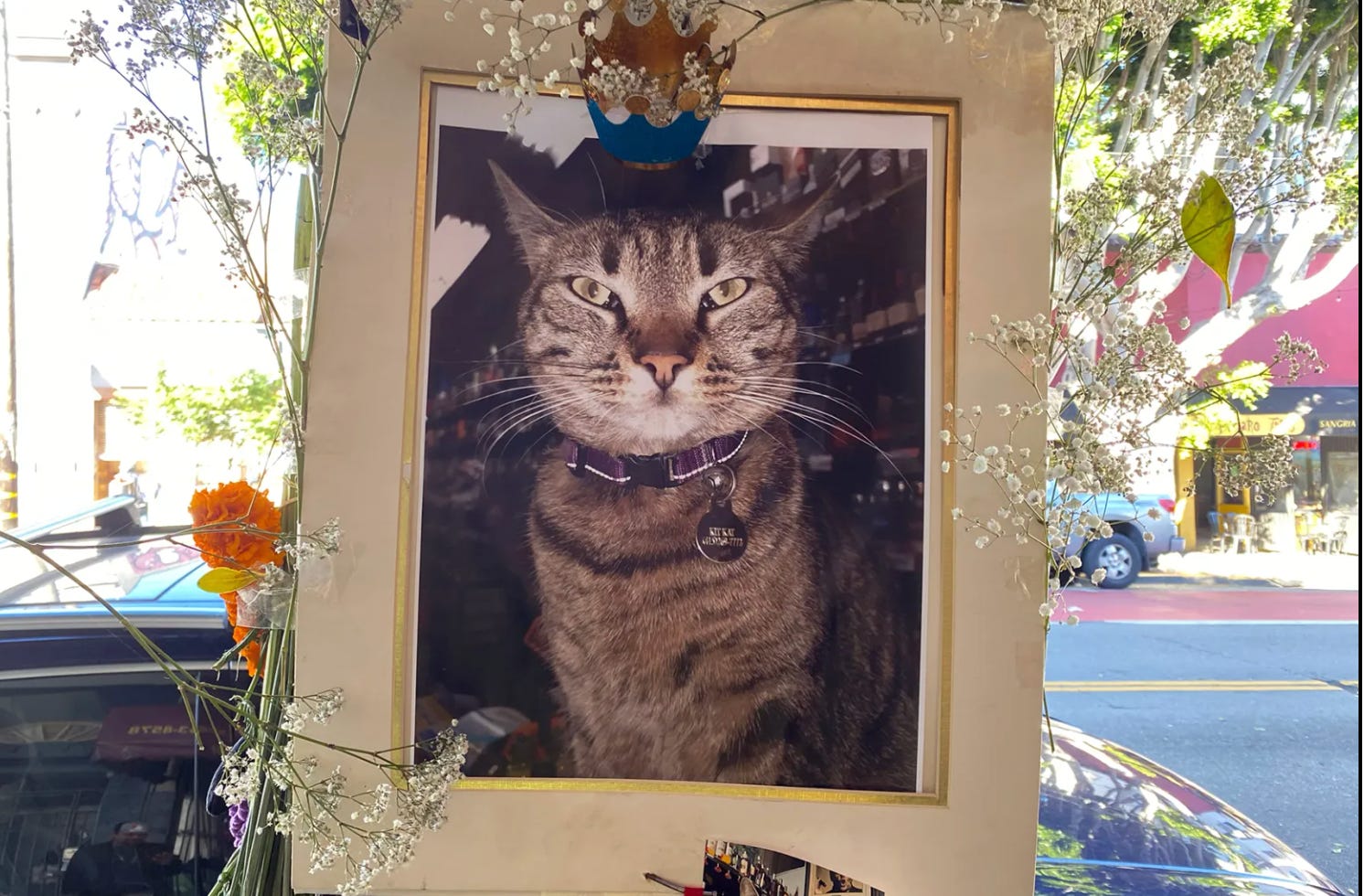
A few weeks ago, the self-driving car company Waymo issued a public statement that one of its vehicles had been in an accident. A beloved neighborhood cat, KitKat, had “darted under our vehicle as it was pulling away,” Waymo claimed. She was crushed and killed, vomiting blood on the street as passers-by screamed.
But last week, the New York Times obtained footage of what actually happened. Far from darting under the vehicle, KitKat in fact had casually strolled in front of the car. Perhaps even more disturbing, a woman had walked over to the car and crouched next to her, encouraging her to get out from under it. The Waymo darted forward and to the left, apparently crushing KitKat at least once, perhaps twice, as the woman jumped up and down and screamed.
When the public found out about KitKat’s killing, there was was mass outcry. A supervisor in San Francisco made a video mourning her death. But Silicon Valley was united in its enmity towards anyone who probed her death. Jeremy Stoppelman, CEO of Yelp, was among many who complained that the death of a “stray cat” was making “national news.”
I don’t want to really comment on whether Waymo’s are, in fact, safer for human beings and animals. (I’ll just say, for now, that the analysis has been done is dreadfully unsophisticated and naive.) What I do want to say is that Silicon Valley’s response to KitKat’s death demonstrates a tone deaf, borderline sociopathic tendency, that we see among the tech elite. It goes something like this: “You’ll accept what we’re giving you, even if we lie about it, even if it kills you! And you’ll be grateful for it!”
At a moment when the entire nation, the entire world, is concerned about the massive inequality, and existential risk, posed by the concentration of power in Tech, surely some of the leaders of tech would show empathy or humility towards a vulnerable being literally crushed by their actions. Instead, the tech companies and their defenders lied, insulted people who were grieving, and made no effort to make amends for a vulnerable being’s death. This is a bad sign for tech. It’s a bad sign for the future. It’s a bad sign for human civilization, so long as we remain wrapped around tech’s proverbial finger — economically, politically, and (increasingly) even physically, too.
What needs to happen, I think, is something that many in tech are familiar with, at least those involved in AI research. The tech industry, and our democracy, need to build algorithms more responsive to data. Right now, the preferences and attitudes of a small number of people are controlling the wealth and technology of human civilization. This is not just profoundly unfair—tech’s wealth is built on the attention and knowledge generated by all of us—but bad for the future of sentient life.
I don’t believe representative democracy is the responsive algorithm we are looking for. I don’t know, entirely, what is. But what I can say is this: if tech doesn’t start updating our system’s parameters based on the data of democracy, we are heading for dark times ahead.