

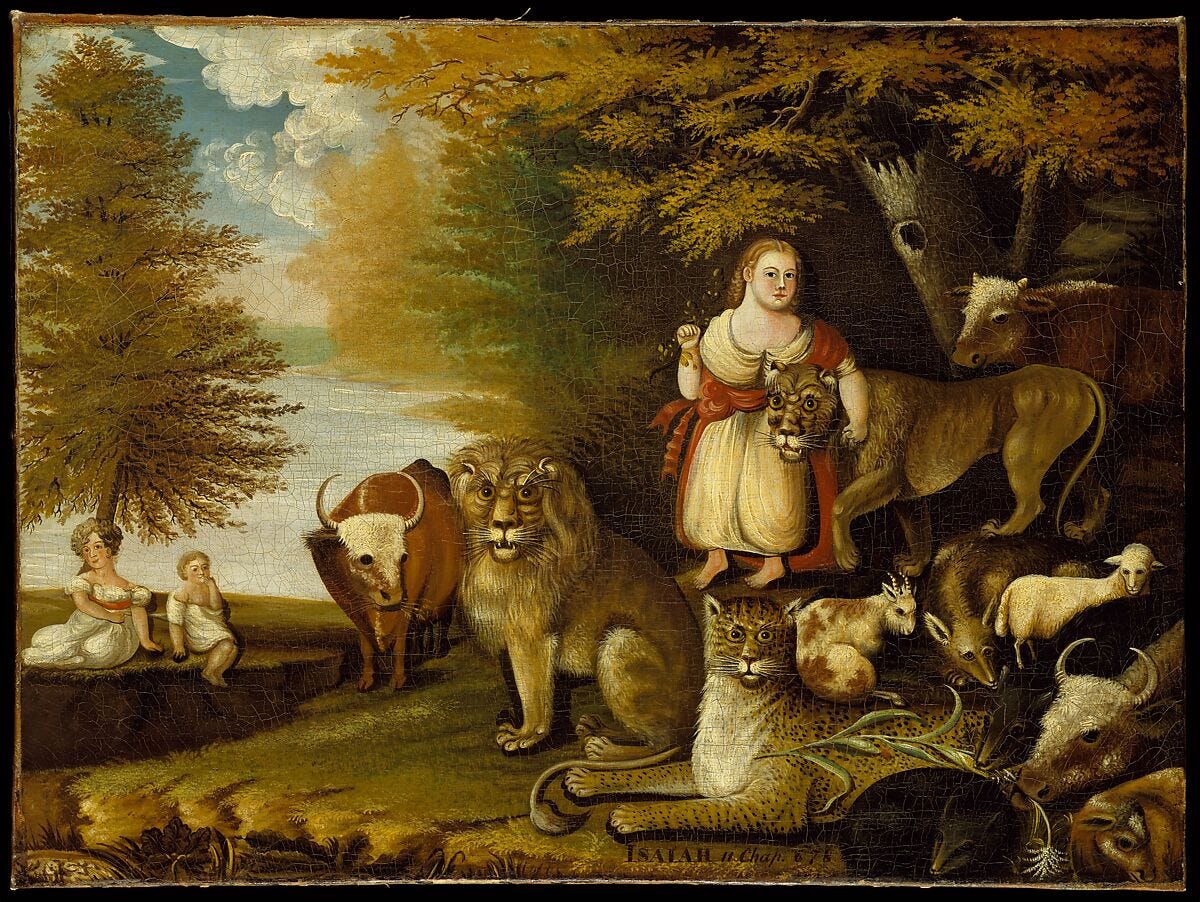
In the beginning, God created animals. And it was very good.
The biblical story of animal liberation is not one that is commonly discussed. But God bestows his love not just on humanity but on all sentient beings. He blesses animals upon their creation in the book of Genesis. He includes animals in his vision of a “covenant of peace” in the book of Isaiah. And perhaps most shockingly, Jesus is corrected in the book of Mark on the question of whether animals deserve kindness. In all these cases, the story of the Bible is one where the arc of the moral universe bends toward (animal) justice.
The first instance of this narrative occurs in Genesis 1:20. God says, “Let the waters bring forth swarms of living creatures, and let birds fly above the earth across the dome of the sky.” But God does not just create the animals. He blesses them, too (Genesis 1:22). This blessing creates a moral distinction between animals and all the creation that came before. God did not bless the creation of light on Day 1. He did not bless the sky on Day 2. He did not bless the creation of plants on Day 3. And he did not bless the sun and moon on Day 4. It was not until animals were created on Day 5, and humankind on Day 6, that blessings were bestowed.
Blessings throughout the Bible are given to beloved members of the community. That is why Abraham’s pact with God in Genesis 12 involves the blessing of a nation. It is why Jacob conspires with his mother to obtain his father Isaac’s blessing in Genesis 27. The act of blessing, in the Bible, is only given to those who are chosen. The animals, then, were arguably the first chosen people of God.
There is, of course, the tricky language in Genesis 1:28; God gives humanity the right to dominion over “every living being that moves upon the earth.” But dominion does not imply that the animals are unloved, or even lesser beings. God himself, after all, exerts his dominion over humanity with violence in the story of Noah in Genesis 7. That does not imply that humanity is unloved. To the contrary, dominion implies that one’s subjects are deserving of consideration; one cannot have dominion over plants and rocks. Dominion implies that one has subjects who are not mere things for the ruler to use.
The second story of animal liberation, from Isaiah, reinforces the expansive moral vision of Genesis. After the fall of the biblical kingdom of Jerusalem to the Babylonian King Nebuchadnezzar, the children of God are forced into exile. The temple is burned, and the people are enslaved and brought to exile in Babylon.
The prophecy of Isaiah offers a return to peace. The famous passage of Isaiah 40 notes that Jerusalem has “served her term” and that the “penalty is paid.” God will now “gather the lambs in his arms” and, in Isaiah 54, establish an eternal “covenant of peace.” It is important that the people of God are compared to lambs. Equivalence between man and animal is once again established; in this case, they are both beneficiaries of a new peace. But how do we know this comparison has real moral weight, rather than a metaphor used for rhetorical purpose?
The answer comes earlier in Isaiah in Chapter 11, where the vision of the “Peaceable Kingdom” is established. In this Kingdom, where God will “assemble the outcasts of Israel,” (Isaiah 11:12) “righteousness” and “equity” will rule. And this will include righteousness, equity, and peace for all sentient beings: “The wolf shall live with the lamb, the leopard shall lie down with the kid, the calf and the lion and the fatling together, and a little child shall lead them” (Isaiah 11:6). This should not be surprising, given what we know of God’s first blessing in Genesis. But it shows something important. Not just in creation, but salvation from violence, God’s moral vision includes compassion for nonhuman beings.
That brings us to the third and perhaps most shocking story of animal liberation: the correction of Jesus on animal cruelty. There are few, if any, instances of Jesus expressing contempt towards “lesser beings.” Indeed, the gospel of Mark begins with Jesus consorting with lepers (Mark 1:40), sinners, and tax collectors (Mark 2:15-17). Later, Jesus uses the parable of the mustard seed growing into a mighty plant to show how even the smallest can be destined for glory (Mark 4:30-32). It’s hard not to think of chickens and mice and even insects when we think of small beings. The biblical story is one of inclusion of these little ones; there is no one beneath God’s love.
But then there is the shocking incident with the Syrophoenician woman, a Gentile who begs Jesus to cure her daughter who is ailing with a demon. Jesus refuses her request and offers her an insult instead: “Let the children be fed first, for it is not fair to take the children’s food and throw it to the dogs” (Mark 7:27). The woman responds, “Sir, even the dogs under the table eat the children’s crumbs” (Mark 7:28). And Jesus humbly approves of her response. “For saying that, you may go—the demon has left your daughter” (Mark 7:29). With those words, the child is cured.
There are at least two things to note about this remarkable passage. The first is that Jesus is conceding that animals must be included in our compassion. His ministry has pushed the envelope of who is loved by God: lepers, sinners, and tax collectors. The dialogue with the Syrophoenician woman shows that this circle of compassion must be pushed to include animals as well. Animals have been the subjects of blessing and salvation from God. Why not also love?
But there is a second and even more important point to make. Jesus’s mistake, identified by an ailing mother, was to limit his compassion to only human beings; indeed, it is perhaps the only error by Jesus recorded in the Bible. This has implications beyond the specific story because, if Jesus can be wrong in his cruelty to animals, then Jesus and his father God can be wrong in other things.
And perhaps they are. The story of the Bible is not always filled with peace and kindness. God orders Abraham to slaughter his own child (Genesis 22:2); commands the people of Israel to annihilate the women and children of Amalek (1 Samuel 15:3); and requires the sacrifice of unblemished animals to appease his anger (Deuteronomy 15:21). It is therefore remarkable that when God sends his son to save the earth, Jesus admits that he is wrong to deny compassion to a dog. It is as if God is saying, “I have been cruel, and I was wrong.”
There are fundamental questions of divine fallibility that cannot be answered here. What these three stories do show, however, is that the story of the Bible is the story of people making their moral circles too small. This has dramatic implications for modern Christianity. The Christian right, which dominates the church today, tries to limit compassion to our tribe, our nation, our species. But the central message of the Bible is that this effort to narrow the moral circle leads to calamity. All the people of earth, including those from other species, are the children of God. For that reason, they are deserving of love. The story arc of liberation is not always clear. It is not always linear. And yet these three stories show that the arc is there, and it bends toward (animal) justice.