

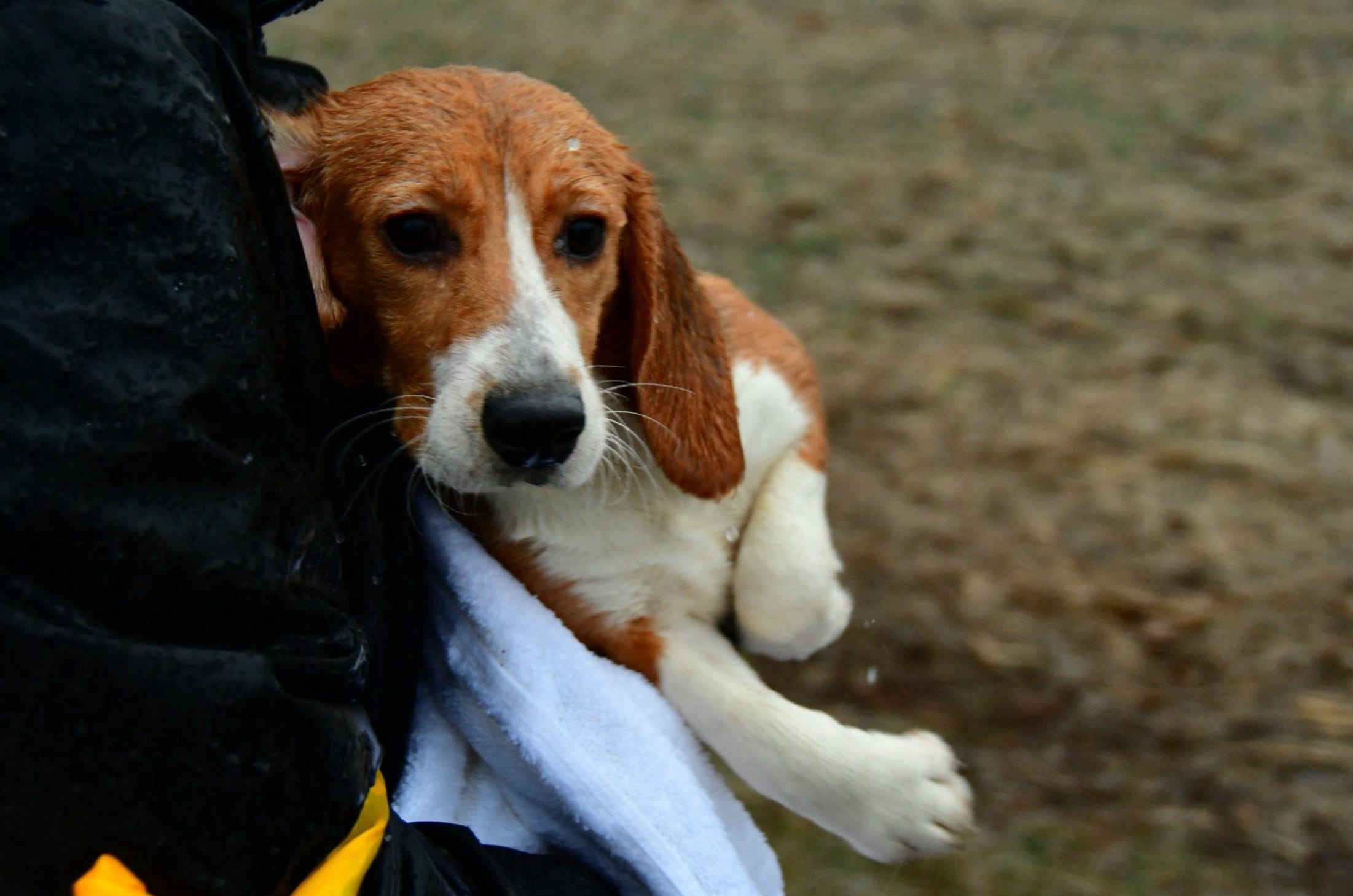
The rescue at Ridglan Farms should have been an impossible mission.
I first broached the idea with experienced activists in late 2025, shortly after special prosecutor Tim Gruenke announced that, despite clear evidence of felony animal abuse at the facility, he would take no action to help the dogs.
My immediate reaction: “If the government won’t save them, we will.”
Come hang out with me tomorrow at 7 pm in Berkeley! I’m in the Bay Area and hosting a short talk and hangout tomorrow (Monday, November 2) at the Berkeley Animal Rights Center at 7 pm for anyone interested in the Ridglan campaign! RSVP here.
But virtually all the veteran activists I talked to told me to forget about it. Ridglan had a barbed wire fence and was on high alert for activists. Years of prosecutions had depleted the open rescue movement of leaders. And the local authorities in Dane County were co-opted by the industry; the special prosecutor bent over backwards to cater to the industry, for example, while refusing to even talk to any of the witnesses of animal abuse at Ridglan Farms. The system was broken and corrupt.
That left us facing seemingly impossible odds. But we took on the mission anyway. And we won. Every one of the Ridglan dogs is now free.
Now, just 7 months later, we face another daunting challenge: rescuing the 16,000 dogs at Marshall BioResources. Once again, people are saying it is an impossible mission, despite disturbing evidence of criminal abuse. Dogs at Marshall are injected with toxins that leave them thrashing and screaming, as if they are being “burned alive from the inside,” according to one witness. Marshall in North Rose is even more fiercely guarded than Ridglan—razor wire apparently covers the grounds of the facility—and it has enormous political influence that protects it from accountability.
But the Marshall rescue can nonetheless be done. In fact, it must be done. To pull it off, however, we have to learn the lessons from Ridglan. Here are some of the important ones.
Lesson 1: Open rescue can create transformative change—under the right conditions.
Open rescue fulfills the two most important goals of any strategy for social change: attention and sympathy.
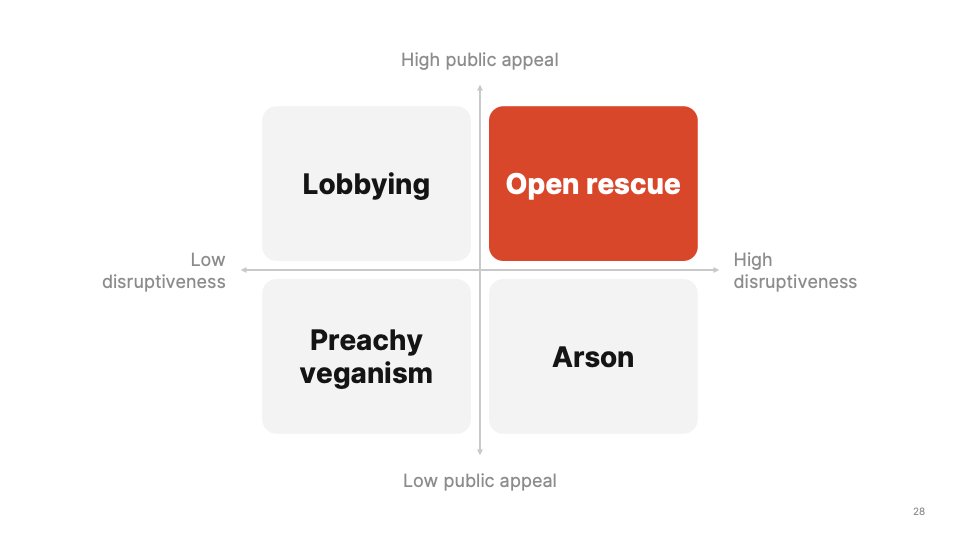
But at Ridglan, we learned two very important lessons about the conditions in which open rescue works. The first condition is transparency. We not only declined to hide our faces at the March rescue. We openly announced we were going to do it months before the action. This allowed us to recruit from a much wider pool of people. It built a dramatic storyline as the date of the rescue approached. And it furthered our case that we have the legal right to rescue animals from abuse. After all, why hide an action if it’s within your legal rights?
The other very important lesson is that numbers matter. The training, communication, and legal support required of mass actions is an enormous project. But unlike many movement leaders, I thought the evidence from the last 10 years showed mass actions were worth the effort. Effective movements are, in no small part, simply a numbers game. Ridglan showed the power of those numbers.
Lesson 2: Find the BHAG.
Historically, big goals have been looked upon with suspicion by the animal movement. The vast majority of the effort and resources go to campaigns that make small, incremental asks—bigger cages or better deaths. In contrast, the Ridglan case had Big Hairy Audacious Goals (BHAG). We not only said we were going to rescue every last one of the Ridglan dogs. We talked about how we were going to save all the animals cruelly used in experiments.
Outside of the animal context, BHAGs are widely understood to be crucial to making big progress. Google’s CEO has spoken about why his company almost always sets ambitious, “moonshot” goals. Big goals inspire the most high impact people to join the effort. Extraordinary people want to work on extraordinary things. Ridglan recruited countless extraordinary people to do something big together.
Lesson 3: Leadership requires soft skills, not charisma.
Traditionally, people think of leaders as charismatic, extroverted, and great speakers. The leaders of the Ridglan campaign were different. Team leads were chosen based mostly on character traits, not charisma. Can this person handle conflict well? Will this person remain nonviolent? Can this person engage effectively with large numbers of people, some of whom will be very different from who they are? These soft leadership skills are increasingly important in a world where movements are built from decentralized social networks, rather than traditional political structures or community organizations (such as churches).
These soft skills are particularly important when leaders are asking people to take on risk. Recent research shows that one of the most important attributes of leadership is the ability to quickly appreciate tradeoffs in activism. If people are going to take risks, they want to know that their leaders are able to appreciate the costs and benefits of each course of action. (Interestingly, the worst leaders were the ones who nominated themselves to be leaders!) But as trust declines, and communities deteriorate, leaders aren’t just responsible for making good decisions. They’re responsible for building mini-communities. It’s the only way to ensure that hard decisions, with difficult trade-offs, are supported.
Lesson 4: AI is a game changer—but only if you’re obsessed.
AI was a massive force amplifier throughout the Ridglan campaign. We used it to research Ridglan and its buyers. We used it to build websites. We even used it to manage conflict resolution processes.
What we consistently found, however, is that people differed dramatically in their ability to use AI effectively. Those who were highly committed to it could produce vastly more output: multiple 20-page legal briefs in a single day; world class websites in minutes; and training documents that were clear, concise, and grounded in scientific evidence.
But when we tried to scale up the use of AI, it generally fell flat. The vast majority of people could not or would not use it effectively. This is consistent with research on AI’s learning function in randomized experiments. Overall, it seems to improve expertise, but this improvement is focused on those who are top performers.
Lesson 5: To win, you need skill at the outside and inside game.
Most animal rights groups try to play outside (grassroots, protest, direct action) or inside (lobbying, persuasion, negotiation). We did both, and it worked. The campaign started with direct action, the open rescue of dogs in 2017. But then it moved to the inside game. Petitioning the government for a special prosecutor and passing local legislation. Combining the inside and outside games is something that successful social movements, such as the Civil Rights Movement of the 1960s, did extremely well. We are learning to do the same.
Lesson 6: Pitch a tent so big it’s a little uncomfortable.
In a world that’s highly polarized, it’s hard to build a large, diverse grassroots movement. People immediately attack one another for political differences. But that’s precisely what movements need: numbers create power, and diversity shows that power is not a niche element of society. To solve this problem, we went out of our way to say, “We are building a tent so big it would make you a little uncomfortable.” The result was a movement that had leftist Jen Welch and MAGA influencer Lara Trump in the same coalition. To win at Marshall, we’ll have to pitch a similarly big tent.
Lesson 7: Delete the rules. Focus on values.
Scale usually requires bureaucracy. And bureaucracy kills initiative and flexibility. When people see hard rules that clearly don’t work, they get frustrated and leave. As much as possible, we tried to eliminate these rules, and the many other permission structures that frustrate movements as they scale up, and focus instead on shared values.1 For example, our code of conduct was two words: be cool. For another, we rarely, if ever, told people not to take a certain course of action. Instead, we just asked them a values-based question: “Is your action nonviolent?”
To get the speed and scale necessary to save the dogs at Marshall, we’ll have to take a similar approach.
What else is going on?
Preliminary hearings and arraignment for 47 new defendants in the Ridglan case. Last week, the state brought burglary charges against a large number of additional defendants. I’ll have more to say about the case later this week. For now, this is the highlight: the prosecution is on the defensive, and it showed.
My wife Rose is on trial this week for attempting to protect horses from abuses in the racing industry. She and around 100 other animal activists nonviolently attempted to enter the track and sit on the field peacefully before the Grand National. The authorities arrested her and charged her with conspiracy. They did nothing about the abuses at the track, despite the fact that a horse died in a race within an hour of their demonstration. This will be a very hard case, but I believe in my wife—and the compassion of the people of Britain. I won’t be personally joining this trial, as I’m on doggie care duty (and the trial is very far from London in Liverpool). But I’ll be following it closely and providing updates on X/Twitter.
We should be announcing a new strategy to save the Marshall dogs soon. I and a number of other committed organizers and partners in the campaign to stop the abuses at Marshall, and get all the dogs out, have been in intensive meetings for the last couple days. We hope to announce a new strategic framework for the campaign within a week.
That’s all for now!
Thank you for all you are doing & keeping us informed!💖
Excellent article and great explanation of what has worked and how it came to work!
Continued good luck in this most important of campaigns.
You and your team are true heroes!