

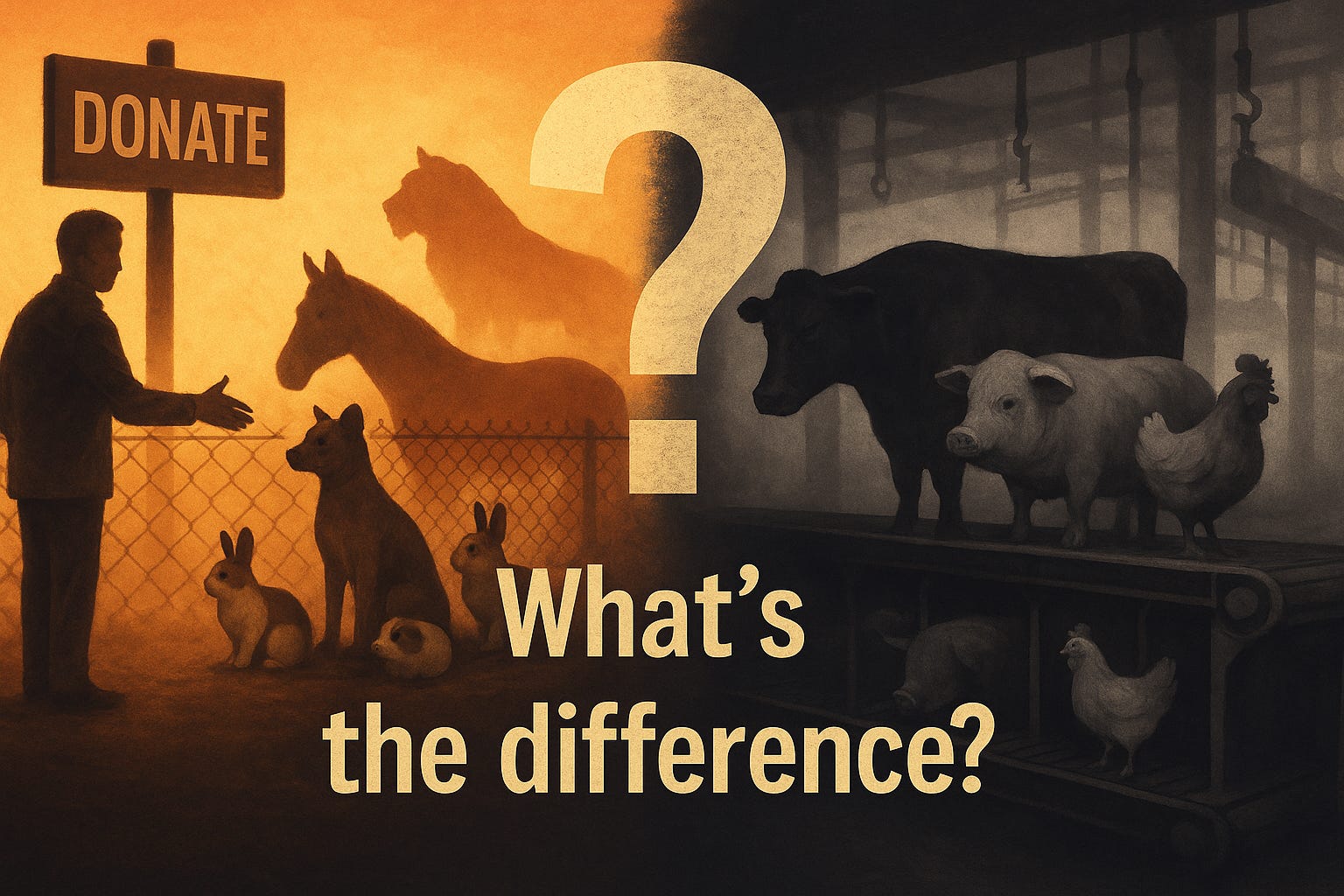
Increasingly, violence against pets is not just the subject of viral YouTube videos but of international news. Today’s version is a story that a Danish zoo is asking on Facebook for people to “donate” pets they no longer want for the zoo’s carnivores to eat. Horses, guinea pigs, rabbits, and other creatures “make up an important part of the diet of our predators,” which need “whole prey, which is reminiscent of what [predators] would naturally hunt in the wild.” The zoo offered tax deductions for anyone who made a suitable donation of a pet for slaughter.
The mass public outcry was intense, with the most-liked comment on Facebook accusing the zoo of holding a “perverse and degrading mindset.” Numerous international media outlets, including the New York Times and CNN, covered the story and the public rage. But completely missing from news coverage was a simple idea: what’s the difference between the pets slaughtered for a lion at a zoo, and the animals we slaughter for our fellow human beings to eat?
There are, of course, possible reasons to distinguish those two scenarios. Perhaps the outrage in the zoo case is not about the animal themselves, but a violation of a human’s relationship to a pet. But this explanation fails. The zoo takes animals from situations where the “owner” no longer wants them. There is no relationship between a human being and animal to protect when the owner “donates” them to be killed at the zoo.
Perhaps the difference is that feeding pets to predators at zoos is unusual and unnecessary, as compared to the animals we ourselves kill for meat. But this also fails. Morality is not a popularity contest, dependent on the whims of the public in a particular time and place. And it is no more necessary for us to eat animals than it is for a lion at the zoo. To the contrary, the Danish zoo, at least, can argue that lions are inherent carnivores.
The main reason the media won’t touch the comparison between eating pets and eating meat, I think, is that the comparison just seems too revolutionary. If we were to give all animals the moral consideration we give our pets, then suddenly the entirety of human civilization would become, as Singer put it in 1975, a “tyranny of human over nonhuman animals.” That is not a comfortable place for those sitting in the tyrant’s chair.
But an idea’s revolutionary potential is no reason to reject it. To the contrary, revolutionary ideas grounded in fact and reason have not just withstood the test or time; they have proven more robust than their non-revolutionary (but arbitrary and illogical) counterparts. This includes the idea of moral universalism, which was once revolutionary and seen as virtually impossible to implement. From the Christians who embraced Gentiles to the Americans who embraced universal human rights, it turns out this revolutionary idea had great surviving power. A society is far more stable and successful when it harnesses and coordinates everyone’s abilities and intelligence; that’s only possible under a universalist framework.
Pet lovers already recognize this. Our lives are better when we care for other living beings rather than hurt them. We have the ability to fight and scratch and kill, but it’s a hazardous ability to exercise. The Danish zoo, which now faces an existential crisis, is seeing this firsthand. What they should have realized are happier, smarter, and more secure when we harness a different ability: caring for, rather than slaughtering, other conscious beings.
Because, in the long term, in a world filled with threats and uncertainty, only the compassionate will survive.
Amazing coincidence with the dog-shooting DHS boss and DHS' joking about feeding immigrants to alligators, pythons and mosquitos . . . just for running away from countries controlled by mining magnates, oil magnates, beef magnates. The spark from the US might have lit up a little bonfire of human supremacism on the Grindr coast . . .
On the philosophical pragmatic side, ideals are vitalizing, generative, transcendent and communicative. Our ideals are trans-generational and cross between species, animals sense our kindness, and communicate it. Communication implies compassion. Compassion survives, cruelty brings ruin on itself.
The news that a Danish zoo is asking people to donate their no longer wanted pets (chickens, rabbits and guinea pigs preferred, and horses that meet specific criteria) to be "gently euthanized" and fed to the zoo's carnivore population is disturbing and revolting. But when you think about it, it actually isn't any worse than animals in shelters that no one adopts being euthanized and their remains disposed of. And as you say, it's nowhere near as bad as the meat industries that humans support with their wallets by buying animals for food whose entire lives have been nothing but pain, suffering and death. Maybe if the Danish zoo post gains enough media attention and traction, it will open up a discussion and recognition of the atrocities animal agriculture engages in that we are blinded to.