

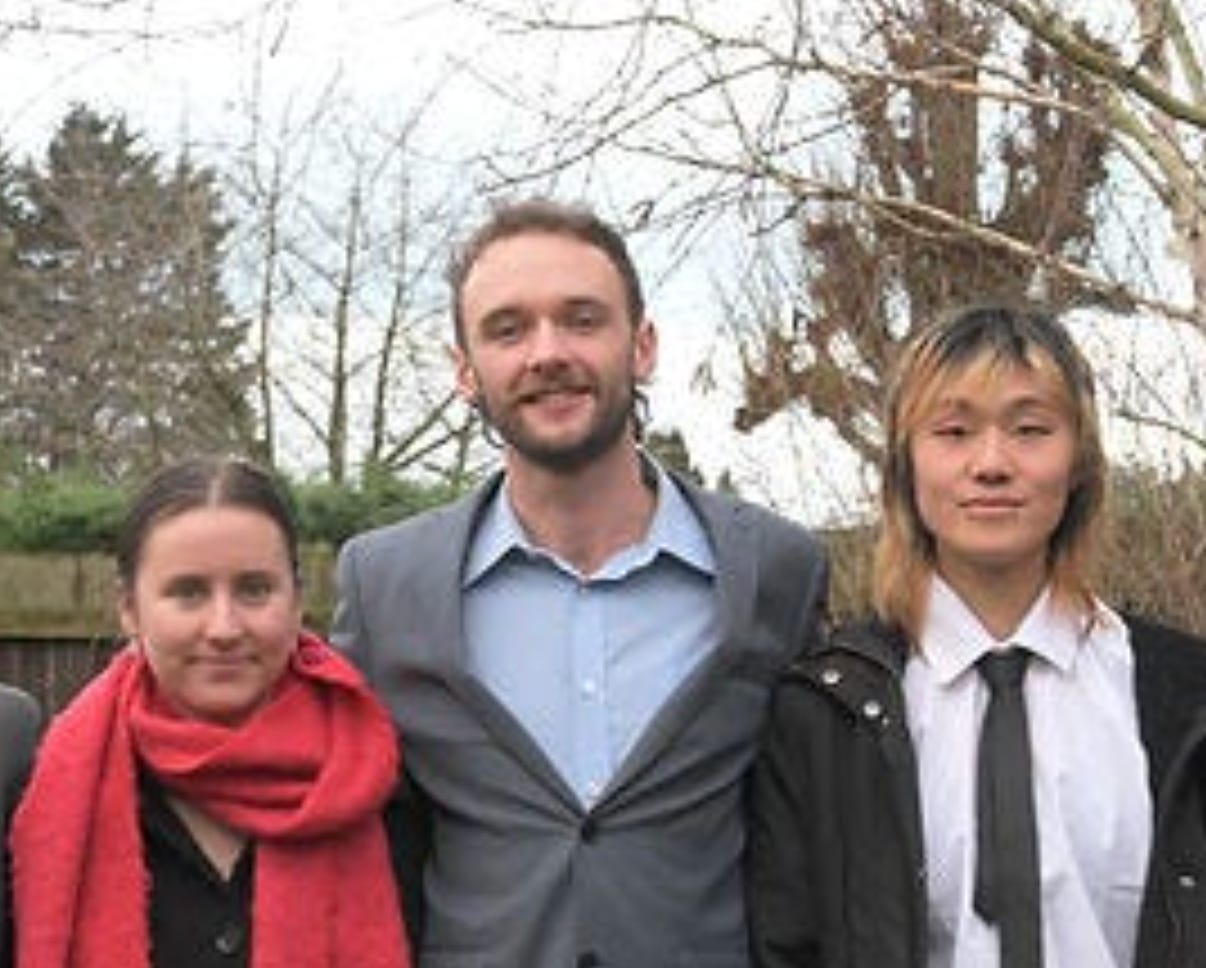
Tom Cusick, a young activist who has never been on trial, delivered a closing argument in the recent beagle rescue trial that left much of the courtroom in tears. Few of us were surprised when the jury came back in record time with a verdict of not guilty. While the attorneys for the other parties, and the prosecution, made excellent legal arguments, all of us afterwards agreed that it was Tom’s speech that, more than anything, carried the day.
With his permission, I’m publishing the full text of his closing—with some commentary by me. There are lessons for all of us in the business of change.
Members of the jury, thank you for being so engaged throughout this trial, I’ve seen you all taking notes and this is something that really means a lot to me so thank you.
Tom starts by thanking the jury, and noting something specific they did that he’s grateful. This is important when you are trying to persuade. Reciprocity—being kind to someone who is kind to you—is part of the human condition.
Now I’m not a lawyer and so I can’t really dazzle you with legal arguments but I think our defence is quite a simple one so I will explain how I see it.
As the prosecution said in their opening statement, the burden of proof is entirely on them. They have to convince you, without a shadow of a doubt, that I am guilty of burglary. If there is any doubt in your mind about this then I must be not guilty.
The main feedback I gave Tom is that starting with legal technicalities is usually not ideal. Both to seize attention, and to make your speech memorable, start with something stronger. This is sometimes called a Power Statement. For example: "What did that night to help dogs was not dishonest. It was the truest thing I've ever done."
I’m sorry to have to tell you all again what the definition of burglary is, but it is important for this case. It comes under the Theft Act, and this act defines theft as such:
*A person is guilty of theft if he dishonestly appropriates property belonging to another with the intention of permanently depriving the other of it;*
My defence focuses on one word in that sentence. Dishonesty. I am not trying to skirt around the law, this is not some act of anarchy, instead I truly do not believe I acted dishonestly and so I do not believe that what I did was burglary under the law. I acted in accordance with my beliefs to rescue puppies. And while I did not trespass on MBR acres or handle any of the puppies myself, I absolutely was part of the plan to to take them to safe and loving homes. I have stood before you and honestly explained who I am and why I took part in the rescue, and I have not once tried to deceive you as to what I did or why I did it. And I will say it again, I was a part of the plan that rescued 18 beagle puppies from cruel and short lives and took them to loving homes where they can now live out healthy and happy lives.
The transparency here is powerful. In past trials, jurors have told us they appreciated our candor. Tom does not try to offer some legalistic defense, based on his lack if direct involvement. Instead, he owns his actions and explains why they were right.
The test of honesty being used in this trial is a two part test.
The first part is to decide if myself or my other defendants held our beliefs honestly. Now the prosecution don’t contest this, they agree that we did strongly hold the beliefs that led us to doing this rescue. For me this was the belief that no dog deserves to live in this place, this place you have seen in the videos, this place where they are kept in cages with no bedding, the only enrichment is a ball hanging from a chain, and they are left covered in their own excrement. For some of these puppies this is their whole lives until they are bled to death, and for others it is where they wait before they are sent to off to labs to undergo unjust and cruel tests. For me this was an immediate threat, the dogs were living in those conditions, they were going to be killed.
This was the part where I started noticing people in court tearing up. There is something incredibly powerful about people bearing witness to animal suffering when the stakes are so dire. And, as with all good persuasion, Tom includes vivid, concrete details, such as the ball hanging from a chain.
It feels like a long time ago now but you might remember in his opening speech, and again today, the prosecution called these puppies “property like a can of baked beans”, I strongly disagree with this statement. Their lives hold so much more value than a can of baked beans. As I mentioned with Pepita the chihuahua in my evidence, I believe that all dogs deserve the chance to grow old with a loving family and because of my actions there are now 18 beagle puppies who have been given this chance.
This point was incredibly powerful. The prosecutor’s description of the dogs as equal to “a can of baked beans” was outrageous. But he was making a nuanced point. This may be the way the industry treats the animals. And you may not like that. But the law is the law, and you have an obligation to follow the law.
Tom directly challenges that by saying that animals are more than things, and, even more important, setting out a vision of what animals actually are: sentient beings who “deserve the chance to grow old with a loving family.”
The second part of the test is:
*In those circumstances, did those actions fall below the standards of an ordinary and decent person?*
Dishonesty is a term based in morals, and because of this ordinary people can disagree on what is dishonest. What can settle these disagreements sometimes is context. I believe there is a big difference between an ordinary person who knows what happens in MBR acres and an ordinary person who does not. I consider myself an ordinary person. I have no criminal convictions, and when I found out what happens at MBR acres I decided to help rescue puppies. Every one of you in the jury is also an ordinary person. If any of you believe that our actions were reasonable given the context then we must pass that test. Even if only one of you thinks that our actions were honest then we pass this test and therefore do not meet the definition of burglary.
It’s very interesting because Tom doesn’t accurately state the test. The jurors don’t actually need to conclude his action were reasonable, just that they were honest. Tom set a higher standard for himself and the other defendants. But they still passed the test.
Dishonesty is often more of a feeling, you can feel when an action is dishonest, it’s in your gut. It is the same feeling when you’re watching the bad guy in a movie, it can be the distinction between doing the right thing and doing the wrong thing.
I loved, loved, loved this line! I’ve spoken many times previously about how different activist cases are from traditional criminal defense. We are not trying to sow doubt. We are inspiring the jury to make a decision of conscience. Tom sets out that challenge very vividly through an example—the feeling you get when you watch the bad guy in a movie. Simple and brilliant.
Dishonesty has been a part of the theft act since 1968, where it has remained unchanged. Parliament have not changed this definition because they understand that events like this are not always straight forward. They understand that sometimes it needs to be left to a jury of 12 ordinary people to make the final call on what is legal. The way I see the power of juries is not that you are 12 blank slates but that you are 12 individuals with your own life experiences, your own moral beliefs that when brought together as a group can lead to the fairest verdict.
I thought Tom veered very close to asking for jury nullification here. Juries are entitled to ignore the law and acquit someone, but strangely, no one is allowed to tell them this. If he were an attorney, Tom might have gotten in trouble. This is the power of a self-represented defendant.
Now the prosecution seems to be that we were not honest because we were filming? Because we posted videos online, videos where we openly and accountably rescued puppies and showed the exact conditions in which we rescued them from. Videos that tell the stories of the puppies we couldn’t save that night, puppies that, only 3 years later, are more than likely dead now. And videos that tell a story of hope for the 18 beagles that are still alive, alive and loved in safe homes, alive only because of what myself and my fellow rescuers did on that night.
The prosecution claim our actions weren’t honest because we don’t agree with animal testing but it is important to remember the one and only reason these puppies are there is because they are tested on.
The prosecution claims that I was a part of some highly organised military style operation. I mean you all saw the video of Mr Guthrie shuffling about with his trousers around his ankles. The truth is really a lot simpler, what I really am is just a person who loves animals and is willing to go to lengths to helps them, whether that means traveling to Ukraine to rescue dogs from war or just feeding the pigeons down by the canal.
This was the moment where I became nearly 100% convinced the jury would acquit. I thought to myself, this jury is not going to convict someone who traveled to Ukraine to rescue dogs from war zones!
This reminds me of the story of Alexandra Paul, in the Foster Farm trial, allowing a homeless person to just move into her home for a few months. Character evidence of this sort really matters! People need to hear the story of who the activists are, not just what they did. And if they like what they hear, they’ll probably acquit.
Everything I did that night I did honestly in line with my beliefs that these dogs deserved better and I am incredibly proud of what I did that night. I am willing to accept whatever happens to me because of it but I hope that if any one of you agree that my actions were honest then you can find me not guilty.
I know this trial is not the most straightforward trial you could have got and at times it has been emotional, but it’s now I’ve said all that I can, it is entirely in your hands to decide if it was a burglary or a puppy rescue. Thank you again for listening.
This is a powerful dichotomy: burglary or rescue? The jury made its decision.
This moved me to tears. Tom’s open innocence beauty and powerful yet vulnerability matches the puppies he saved. Thank you for sharing.
Tom's honest explanation of why he rescued the dogs to take them to safe and loving homes is from the heart. It grabs your heart and makes you question if you would do the same thing if you saw dogs in such distress. Beautifully done!