

This is a report from the frontlines.
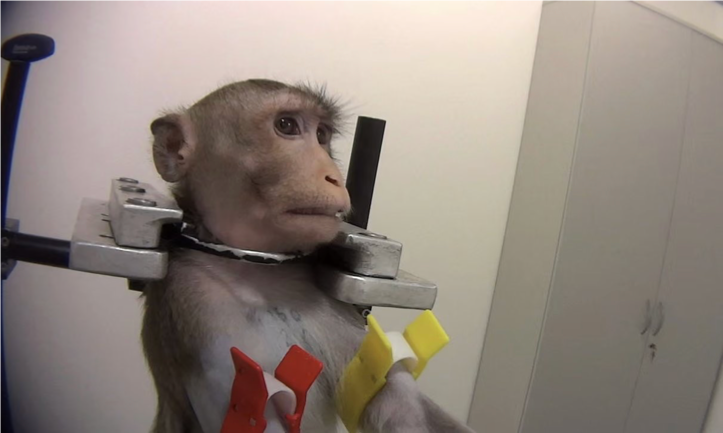
We have broken into Elon Musk’s lab, Neuralink, and we can see a primate, a macaque. Through a crack in the vent, we’ve placed a camera that sees everything. The macaque is pinned down with arm and neck restraints. A power drill is on the table next to her. Soon, they will drill metal rods into her head, so they can access her precious brain for experiments. She screams and thrashes, but she cannot escape.
Suddenly, we hear a noise in the hallway. A light turns on, and three men with grim faces appear. They stare at us, shocked by our presence.
“How did you get here?” one shouts.
This is the point we’ve been dreading. A direct confrontation between the animal abusers and animal rescuers at the very site of the violence.
But then something surprising happens: the men with grim faces flee. One jumps over a gate and crashes through a window. Another pulls open a latrine cover and crawls through. The third leaps, grabs onto a railing above him, swings up, and squeezes through a hole in the roof.
“Stop!” I yell, as I run after the men. But they’ve disappeared into the night.
“Call it in.”
Within an hour, dozens of ambulances stream in, and EMTs rush into the facility. The macaques are gently coaxed, two at a time, into the back of spacious trailers with bedding, food, and water. Their babies are placed in special heated trucks; trained staff stay with them, offering infant formula to help them recover from trauma. Helicopters airlift a few to a local hospital to receive emergency intensive care. Within 4 hours, all the animals at Neuralink have been saved.
This is a report from the frontlines. The year is 2060. Five years ago, every nation signed a universal declaration of animal rights. And today, we are shutting down the last animal abuser on Earth.
I began my talk at the Vegan and Animal Rights Conference (VARC) in March with this fictional story, based on a similar story I told in 2016. I meant for the story to illustrate the world we can create together—a world where every animal is safe, happy, and free.
But the story was also meant to create accountability. Ten years ago, I and other organizers at the grassroots animal rights network Direct Action Everywhere (DxE) challenged our movement to think bigger: to achieve our greatest dream, animal liberation, in a single generation. We predicted that it would happen by 2055. And the victory at Ridglan this week shows we’re making progress that’s even faster than I would have guessed. The fictional story I told in 2016 is coming to life.
There are three reasons why.
First, institutions are transforming. As I set out in the talk, institutions often seem hard to change. But once change starts, especially when it comes to the expansion of rights, it’s very hard to stop. When I started as an animal advocate in 1999, there were zero state farm animal protection laws. Twenty years ago, there was exactly one. Now there are at least 44.
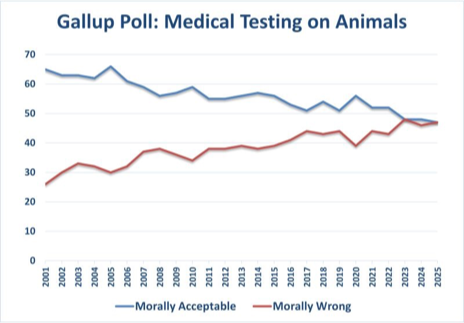
Second, culture is shifting. Twenty years ago, the vast majority of Americans supported medical testing on animals. Today, half are against it. Indeed, it is one of the few moral issues that has seen consistent momentum in one direction over the last 20 years.
Third, movement power is exploding. In 2006, when anti-vivisection activists were hit with lawsuits and serious criminal charges, the movement fell apart. We simply didn’t have the support and resources to take on the corrupt alliance between the industry and the state. Today, things have dramatically changed. We have lawyers, media connections, and (above all) the diverse grassroots support that a movement needs to take on powerful industries and win.
What this adds up to is rapid change—change that can happen in one generation (or even faster). I’m doubling down on my prediction from 2016 and saying we will achieve animal liberation even faster: by 2040, not 2055.1 But I’m interested in your take. Will we see an end to institutionalized animal cruelty in our lifetimes?
I’ll note that predictions beyond 10 years necessarily have very large error bars! So it’s hard to know the exact date. But it seems clear to me that things are moving faster.
Another important change is technological. Advances in computer modeling and in organ-on-a-chip science have made most if not all animal testing unnecessary.
The world we can and will create. Together. Within our life time with all future generations remaining vigilant as there will always be humans who live by ends justify means. Other-than-humans can't give consent. We have more effective means: Consenting humans, assays and computer models. Thank you, Wayne and all compassionate beings in this struggle: Justice for the voiceless, those who can't advocate for themselves. We hear your cries.